Further confirmation of the "southern route" hypothesis comes from a very recent paper, just published in the December edition of Science, Mapping Human Genetic Diversity in Asia, by "The HUGO Pan-Asian SNP Consortium":
More than 90% of East Asian (EA) haplotypes could be found in either Southeast Asian (SEA) or Central-South Asian (CSA) populations and show clinal structure with haplotype diversity decreasing from south to north. Furthermore, 50% of EA haplotypes were found in SEA only and 5% were found in CSA only, indicating that SEA was a major geographic source of EA populations (from the Abstract -- my emphasis).Evidence for important founder effects in South Asia, as suggested by both Oppenheimer and Soares et al., comes from another recent paper, published in Nature last September, Reconstructing Indian population history, by David Reich et al: "Allele frequency differences between groups in India . . . [reflect] strong founder effects whose signatures have been maintained for thousands of years owing to endogamy" [my emphasis]. So strong are these effects that they are believed to have an important influence on the health of the population generally:
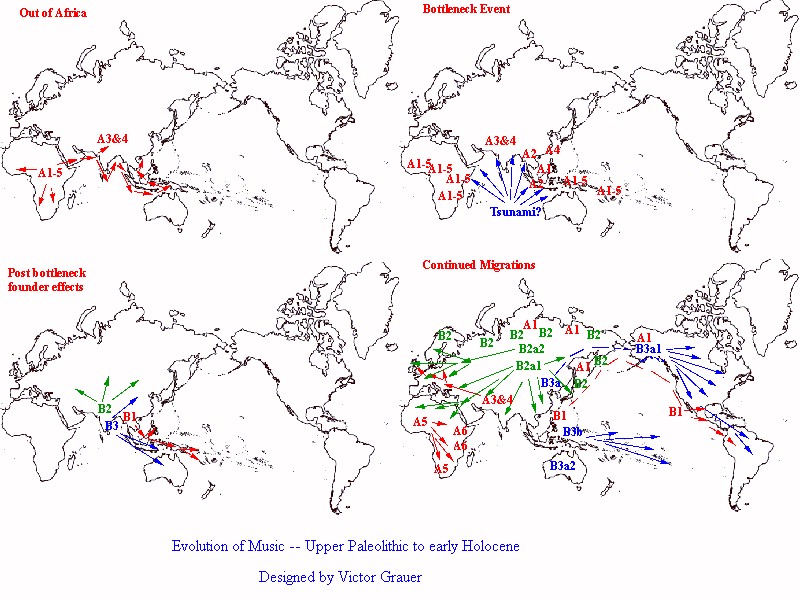
The large number of Indian lineages with a history of founder effects is consistent with the notion that South Asia could have been subject to a major population bottleneck during the Out of Africa migration, possibly due to a catastrophic event such as the Toba explosion, a Tsunami, major flooding, or a widespread, long-lasting drought. As I suggested in my "Echoes" paper, an event such as this could have had a major impact on the culture of the surviving groups, which could explain both the absence of much trace of P/B musical style, and the absence of tone language in this region. In other words, the "strong founder events" reported in this paper may have been a major factor in human evolution, genetic, morphological and cultural, at a crucial moment in history.The widespread history of founder events in India is also medically significant because it predicts a high rate of recessive disease. In Finland, there is a high rate of recessive diseases that has been shown to be due to a founder event, and that has resulted in a minimum FST of 0.005 with other European groups. Our data show that many Indian groups have a minimum FST with all other groups that is at least as large. . .
By showing that a large proportion of Indian groups descend from strong founder events, these results highlight the importance of identifying recessive diseases in these groups and mapping causal genes [my emphasis].
As is well known, certain tribal groups in South Asia have been described as "Australoids," due to their striking resemblance to Australian aboriginal peoples, which has suggested to many an archaic connection between the two regions. As I wrote in "Echoes of our Forgotten Ancestors,"
Is it possible that Australia, populated, at least 10,000 years after the Toba blast, could have been occupied by one of the altered survivor lines out of South Asia? Could that also explain the musical discrepancies between Australia and the rest of the out-of-Africa P/B style singer-players? Could that population have simply lost its polyphony, its hocketing, its panpipes, etc. asWhile a genetic connection between south Asiatic tribal peoples and Australian aborigines has been debated for years, a recent paper on that topic, Reconstructing Indian-Australian phylogenetic link, by Satich Kumar et al., though modest, does support such a possibility:
a result of an ages-old natural catastrophe, and been forced to invent itself anew?
Our complete mtDNA sequencing of 966 individuals from 26 relic populations of India identified seven individuals from central Dravidian and Austro-Asiatic tribes who share two basal synonymous mtDNA polymorphisms G8251A and A9156T with
the M42 haplogroup, which is specific to Australian Aborigines. . .
Our results showing a shared mtDNA lineage between Indians and Australian Aborigines provides direct genetic evidence that Australia was populated by modern humans through south Asia following the "Southern Route" (pp. 1-2 -- my emphasis).
The cultural connection would be more convincing if the music of Tribal India were stylistically close to that of native Australia, but it is not. Nevertheless, the absence of both the African musical "signature" and tonal languages in both Tribal India and Australia, whereas both of these important cultural indicators can be found in abundance everywhere else along the Out of Africa path, does seem consistent with genetic evidence pointing to an archaic connection between the two regions. The unusual features attributed to "Australoid" peoples are also consistent with a genetic bottleneck and subsequent founder effect centered in South Asia during the great migration eastward. If the first wave of migrants had already arrived in Southeast Asia by this time, they would have been upwind from the Toba blast and, assuming this as the cause of the bottleneck, relatively unaffected.




 Posts
Posts


