Friday, August 31, 2007

83. Cultural Equity

As I mentioned last time, I'm planning at least one post, or maybe a series, as a collaboration. The idea was to do some writing on cultural equity and then hand the result over to my collaborator (who will remain a mystery man for now). The problem is that, as usual, I've gotten involved in a long argument that needs a bit more elaboration before my collaborator can be expected to sink his teeth into it with any degree of relish, and contribute meaningfully from his own area of expertise: indigenous rights. So please excuse this non-collaborative post, which will eventually, I hope, morph into the promised collaboration.

As I mentioned in the previous post, Alan Lomax founded the Association for Cultural Equity in 1983. In 1996, after he suffered two debilitating strokes, his daughter, Dr. Anna Lomax Wood, took over the helm and has very devotedly and capably directed it since. For more on this still very active organization, with which I’ve been associated for the last few years, I urge you to check out their remarkably rich and impressive website: http://www.culturalequity.org/index.html. Here is an excerpt from their mission statement:

ACE’s mission is to facilitate cultural equity through cultural feedback, the lifelong goal that inspired Alan Lomax’s career and for which the Library of Congress called him a Living Legend. Cultural feedback is an approach to research and public use that provides equity for the people whose music and oral traditions were until recently unrecorded and unrecognized. Cultural equity is the end result of collecting, archiving, repatriating and revitalizing the full range and diversity of the expressive traditions of the world’s people . . .
While Lomax saw cultural equity in terms of justice and equality, I wonder whether he also considered that other meaning of the term “equity,” the one that’s used when we invest in a stock. As he had strong socialist sympathies, this notion, with its capitalist overtones, may not have appealed to him. But aren’t the traditions Lomax championed a kind of equity in that sense as well, as a sort of “common stock” in which our ancestors have been investing since the dawn of humanity, and in which we all share an interest? In that case, what’s at stake is not only a matter of fairness, equal justice for all modes of cultural expression, as important as that surely is, but the preservation of a common heritage, that infinitely precious cultural “equity” of incalculable value to every living human being. As Lomax implies several times in his essay, there is a strong analogy at work linking our efforts to preserve the natural environment, all but universally applauded, with the need for similar efforts on the cultural front, equally important for the well being of our human environment, but unfortunately far less well understood.

If the revisionists of the Kalahari debate are right, then there is no such “equity” to be preserved. If, in the words of Wilmsen and Denbow, “'Bushmen' and 'San' are invented categories and 'Kalahari foragers' an ethnographic reification”; if, as now seems the prevailing ideology among all suitably “postmodern” anthropologists, there is no such thing as “indigenous peoples” at all; if, in fact, the whole idea of culture itself must be understood as an unfortunate illusion, a social construct of dubious value; then what we really have is a relentless process akin, as Lomax suggests, to social Darwinism, in which, since the beginning of life itself, the weakest must inevitably give way to the strongest with the result that only the strongest will survive, to the benefit of all future life forms.

This does indeed seem to have become the prevailing ideology in the field of ethnomusicology, which now sees music as subject to processes of continual change, in force from time immemorial, through which all those traditional forms so beloved by misguided “purists” must inevitably, as has always been the case, give way to those innovations which prove most successful among later generations. To give one example out of a great many that could be cited, here is Michelle Kisliuk’s response to Lomax, from her book on the music of the Aka Pygmies, Sieze the Dance: “Despite Lomax’s good intentions . . . , a study of aesthetics not grounded in lived moments, in the agency of real people, and positioned in terms of the biases of particular researchers, inevitably risks reifying what is by nature specific and ever-changing” (p. 147).

What gives the game away in this case is the word “nature.” All the formidable evidence marshaled by Lomax (and so many others) in support of the notion that certain things may indeed have remained essentially unchanged over countless generations is discounted, and an untested assumption elevated into an eternal truth, by the authority of nature itself! Since “nature” has decreed that all things are “specific and ever-changing,” then all attempts at generalization can be dismissed as “reifications,” continual change from one musical style to another is “only natural,” and thus it is a mistake to argue for either indigenous rights or the preservation of musical traditions. Of course Kisliuk doesn’t really believe all that, as is clear from just about every page of her excellent book, where she continually marvels at the strength and beauty of Aka traditions and defends their indigenous music and belief system against the inroads of over-zealous missionaries: “But the sounds coming at me – loud, forced, unison voices with banging drums – finally so appalled me that I had to escape” (p. 155).

A similar problem was encountered by a man for whom I have always had infinite respect, my beloved teacher and mentor, the late David McAllester, whose essay “The Astonished Ethno-Muse” (Ethnomusicology, vol. 23, no. 2, 1979), a paean to the “one great constant in human culture – which is change,” was especially influential in turning the ideological tide of musical ethnology. McAllester woke up one day to realize that the Navaho people, in whose traditions he’d immersed himself, had, for the last twenty years, been ignoring these traditions in favor of the likes of Waylon Jennings and Don Williams. Country and Western, along with Rock, had become as popular among the Navaho as in the nation at large. A trip to Australia, where “Country and Western is the current popular music of both urban Aboriginals and those on the reserves,” confirmed the revelation. This quickly led to another “awakening,” the realization that “all music is ethnic music . . . We are so captivated by the panpipes in the hawthorns that we hardly hear the music on the TV show in the living room.”

McAllester’s call for a new kind of awareness among ethnomusicologists made a great deal of sense at a time when the field was indeed getting all too bogged down in a narrow and ultimately self defeating absorption in the minutiae of the esoteric and remote at the expense of that which was current, lively and popular, yet all too easily – and unfairly -- taken for granted by the scholarly world. Nevertheless, his core argument comes dangerously close to exactly what Lomax had warned against -- social Darwinism:

After all our impulses to cherish and protect, we should realize that human culture is not a flower with fragile petals ready to drop at the first frosty touch of a new idea. Culture is more like an irresistible plague, pandemic to humankind. New ideas are the food it feeds on, and these can no more be stopped than the perpetuation of life itself (p. 181).
But what if certain specific cultures were in fact fragile flowers, which were indeed dropping at the “frosty touch” of new, more popular, and more powerfully connected, ideas? I wonder whether David really thought through the consequences of what he was writing here, because the Navaho traditions that meant so much to him were in fact, along with so many other, equally fragile, yet important, traditions, dropping to the ground all too quickly, as he himself cheerfully reports. Was that really his point, that the demise of certain traditions doesn’t really matter, because something he refers to as “culture” (talk about a reification!) is healthy enough to roll over all such impediments and ruthlessly (“like an irresistible plague”) perpetuate itself through some variant of Darwin’s basic principle: survival of the fittest?

Tuesday, August 28, 2007

82. Back

OK, finally, after a really nice vacation visiting with friends and family, and a suitable period of recovery, I'm back. There are several projects I'm currently working on: a revival of the Cantometric teaching system, on which I'm working as a consultant/editor; an essay focused on an in-depth music-theoretic comparison of Pygmy and Bushmen vocalizing -- in part a response to Furniss and Olivier (see some of my earlier posts), but also a demonstration of how remarkably similar the two traditions actually are, not only stylistically, but also in terms of some of the most basic elements of musical organization and structure; and an ongoing collaboration with one of the leading figures in genetic anthropology, Sarah Tishkoff, of the University of Maryland, and her associate Floyd Reed -- a comparison of genetic, linguistic and musical evidence in Sub-Saharan Africa. So I hope you'll understand if I won't be maintaining this Blog as regularly as in the past.

Nevertheless, there are some important topics I am planning to cover here, foremost among them the issue, raised by the Kalahari Debate, of indigeneity, what it means and how it effects "us" -- i.e., all of us now living on this planet. And a closely related topic, "Cultural Equity," a phrase coined by Alan Lomax, who founded the "Association for Cultural Equity" in 1983 as part of an effort to link his research on performance style (of which Cantometrics was only one part) with his long term devotion to advocacy on behalf of traditional and minority peoples and their cultures all across the globe. I'll be saying more about Alan's work in this area in future posts, but for now I want to share an especially eloquent statement by him, from his essay "Appeal for Cultural Equity," as published in the Journal of Communication (spring 1977 vol. 27:2). Please read this with great care, as it's even more relevant now than when it was written:

A grey‑out is in progress which, if it continues unchecked, will fill our human skies with the smog of the phoney and cut the families of men off from a vision of their own cultural constellations. A mismanaged, over‑centralized electronic communica­tion system is imposing a few standardized, mass‑produced and cheapened cultures everywhere. The danger inherent in the process is clear. Its folly, its unwanted waste is nowhere more evident than in the field of music. What is happening to the varied musics of mankind is symptomatic of the swift destruction of culture patterns all over the planet.

One can already sense the oppressive dullness and psychic distress of those areas where centralized music industries, exploiting the star system and con­trolling the communication system, put the local musician out of work and silence folk song, tribal ritual, local popular festivities and regional culture. It is ironic to note that during this century, when folklorists and musicologists were studying the varied traditions of the peoples of the earth, their rate of dis­appearance accelerated. This worries us all, but we have grown so accustomed to the dismal view of the carcasses of dead or dying cultures on the human landscape, that we have learned to dismiss this pollution of the human environ­ment as inevitable, and even sensible, since it is wrongly assumed that the weak and unfit among musics and cultures are eliminated in this way. The same rationale holds that war is a necessary evil, since it disposes of weaker nations and surplus populations,

Not only is such a doctrine anti‑human; it is very bad science. It is false Darwinism applied to culture‑especially to its expressive systems, such as music, language and art. Scientific study of cultures, notably of their languages and their musics, shows that all are equally expressive and equally communicat­ive, even though they may symbolize technologies of different levels. In them­selves these symbolic systems are equally valuable: first, because they enrich the lives of the culture or people who employ them and whose psychic balance is threatened when they are destroyed or impoverished; second, because each communicative system (whether verbal, Visual, musical, or even culinary) holds important discoveries about the natural and human environment; and third, because each is a treasure of unknown potential, a collective creation in which some branch of the human species invested its genius across the centuries.

With the disappearance of each of these systems, the human species not only loses a way of viewing, thinking, and feeling but also a way of adjusting to some zone on the planet which fits it and makes it livable; not only that, but we throw away a system of interaction, of fantasy and symbolizing which, in the future, the human race may sorely need. The only way to halt this degradation of man's culture is to commit ourselves to the principle of cultural equity, as we have committed ourselves to the principles of political, social, and economic justice.


These concerns will be the focus of the next post, which is currently being planned as a collaboration. More on this next time.

Wednesday, August 8, 2007

81. Taking a break

I'll be out of town for a week or so, taking a hard earned break from my blog madness. I'll have access to computers, so if anyone wants to email me, please feel free. I might even post here from time to time, but nothing extensive I don't think.

l8r,

Victor

Tuesday, August 7, 2007

80. The Power of Cantometrics: 5

Let's now examine the table presented at the end of the last post, on the distribution of interlock and yodel in Africa. Again, I'll remind you to right-click and select "Open in New Window." Those of you who peeked at this yesterday will notice that it's been expanded, as I decided to take as close a look at those groups who do not fit the pattern as those who do.

You'll notice that the Pygmy groups have been divided in two, with the great majority on the first row and only a small 4 song sample from the so-called "Twa" Pygmies in the second. Actually the word "Twa" is misleading as various Pygmy groups have been given that name by various people at various times. What I'm referring to are the "Twa" of Rwanda, who, in the relatively small sample I've been able to find for them, show no signs of either interlock or yodel. They are the only Pygmy group whose music I've heard who (apparently) do not vocalize in this manner.

Not only do all the other Pygmy groups in the sample employ interlock, but, as should be evident from row 1, this mode of group vocalization would seem to predominate (68%). The Ju'hoansi (aka !Kung) Bushmen are also coded with interlock in the great majority of cases (71%). As with the Pygmies, however, not all Bushmen groups vocalize in this manner. I've already discussed the Khwe group (||Anikhwe) included in the sample, who seem to have assimilated to at least some extent with neighboring Bantus, and sing in typically Bantu "call and response" style.

The Mikea and Wayto (or Weyto) each have a row of their own, as it's not clear to me where they belong. Both are hunter-gatherers, but neither is classed with either Pygmies or Bushmen. As you can see, both groups have been coded with interlock (50%), though the Wayto sample is too small to properly assess. Interlock has not been coded for any of the other hunter-gatherer groups in our sample (El Molo, Hadza and Sandawe), though only the Hadza sample is really adequate to date.

The first seven rows represent hunter-gatherers exclusively. The last two enable us to assess the degree to which interlocked vocalizing (and yodel) is found among all other Sub-Saharan groups sampled. As can be seen in row eight, from a total of 873 songs, only 88, or 10%, employ interlock. Row nine represents a subset of the above, all songs from all such groups with at least one instance of interlock. These are the non-hunter/gatherer groups included, in either red or blue, on the map labeled "Interlock & Yodel in Africa" (see previous post). Here we see an important difference between these groups and (nonassimilated) Pygmies and (Ju'hoansi) Bushmen, because interlock is found only 34% of the time among the former, but 68% and 71% respectively among the latter.

Now let's turn to a consideration of yodel, another highly distinctive and also quite rare, mode of vocalizing. It's found among (mainstream) Pygmies 57% and Ju'hoansi 71% of the time, just about as common as interlock in both groups, and 50% among the Mikea -- but not at all among the Wayto, Twa or Khwe groups, nor any of the other hunter-gatherers. (I must add that yodelling has not been found among the Bedzan, the only Pygmy group in our sample, aside from the "Twa," which lacks this very distinctive and characteristic vocal device, suggesting something unusual in their history that warrants further examination.) From rows eight and nine we see that yodel is found in only 5% of our non-hunter/gatherer groups and not much more, 9%, among all such groups using interlock. Clearly, the use of both interlock and yodel is characteristic of most Pygmy and Bushmen vocalizing, yet rare in either Africa or anywhere else.

In post 76, I wrote:
it's not enough to simply identify similarities between one group and another. To establish that such similarities are meaningful, one must also identify significant differences between these groups and all others, then look for patterns based on both. This is where the method Lomax called "Cantometrics" comes in and why it is so important. Using Cantometrics we can search not only for similarities but also differences, seeking out patterns of all sorts, from the strictly local to the most wide ranging, encompassing vocal styles from all over the world.
This is exactly what I've been doing in these last two posts. We can learn only so much from informal listening, as we have no way of knowing about all the many examples we haven't heard, and whether they would be similar to or different from the few we have. Working ones way through the literature isn't much better, because it's all too easy to get lost in all the details and too difficult to keep track of what goes with what and what doesn't. It may seem all too obvious to suggest that some sort of methodology, either Cantometrics or something similar, is needed for meaningful comparisons to be drawn, but the sad truth is that Cantometrics has been rejected and no other methodology has emerged to replace it. I won't comment further on the current state of ethnomusicology in this post.

By using various types of relatively simple, easily understandable statistics, drawn from the Cantometrics database, to assess both similarities and differences, using both the worldwide and African samples, we have been more objectively able, thanks to the power of Cantometrics, to support the claim that there is indeed something very special and unusual about the musical traditions of the Pygmies and Bushmen of Africa.

Monday, August 6, 2007

79. The Power of Cantometrics: 4

At this point, you should have a pretty good idea of how Cantometrics works. Now I'd like to show you how the encoded data can be put to use. Since I've recently been posting on the special connection between Pygmy and Bushmen music, with reference to the Kalahari debate, let's use the database to take a closer look at how two especially distinctive and characteristic features of both traditions, interlock and yodel, are distributed worldwide.

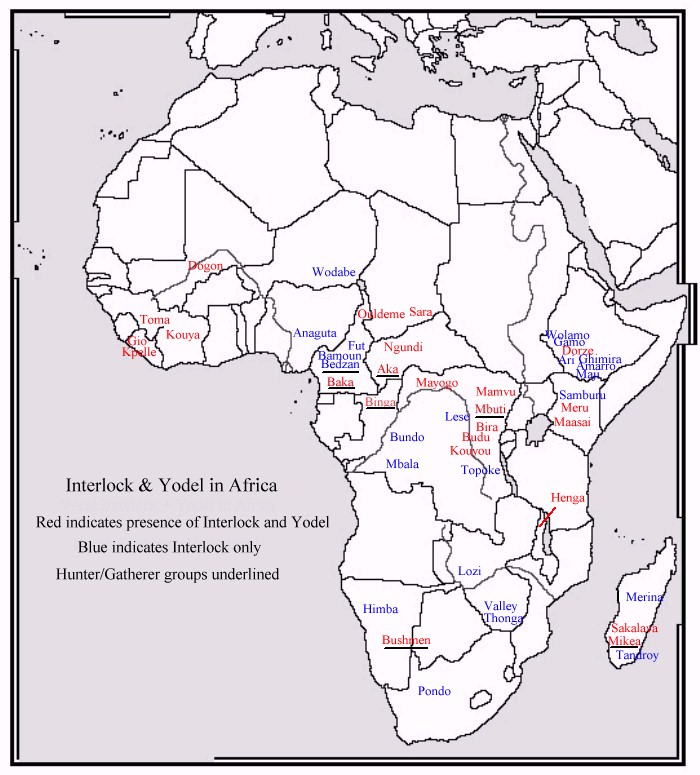
The results for Interlock are presented on this table, broken down according to area. (Those areas where no interlocked performances were coded are not included in the list.) I suggest right clicking on the above link and choosing "Open in New Window," so you can examine the list and continue reading here. The leftmost column lists area names, the middle column total sample size for each area, and the rightmost column the percentage of interlocked performances from each sample. "African Gatherers," a little more than halfway down the list, has by far the highest percentage: 57.78%. Interestingly, the next highest area is among native Americans in California, where 30.56% percent of the sample is coded as interlock, thanks largely to a very unusual tradition of interlocked vocalizing among the Hupa. Such a practice is not at all typical for native Americans north of Mexico, but not uncommon among the Inuit, far to the north, as well as the Ainu of Japan. (See my comments on "shouted hocket," below.) Next highest is 28.8% for the Horn of Africa, largely due to the many unusual tribal groups in southwest Ethiopia who sing in a type of interlocked polyphony very similar to that of Pygmies and Bushmen (though mostly without yodel), as discussed below. No other area is represented by more than 17%. I've already written a fair amount regarding interlock as part of an "African signature" found among various indigenous groups worldwide, so it isn't surprising to see it cropping up in areas like Melanesia, Indonesia, South America, etc., as well as various parts of Africa, as already discussed. Nevertheless, what remains especially important with respect to the interpretation offered here of the Kalahari debate, is the extraordinarily high percentage of interlock among African Gatherers.

Let's take a look at a very similar table, depicting the world distribution of yodel. Again, the African Gatherer sample stands out, at 52.22%. No other area is represented by much more than 13%.

Now that we have some idea where interlock and yodel would seem to fit in the world picture, let's return our attention to Africa, taking another look at a Cantometric-based map I presented in an earlier post, indicating the distribution of interlock and yodel on that continent.


While the map shows us where interlock, both by itself and combined with yodel, can be found, it's somewhat misleading, because, even if only one instance of interlock (or interlock + yodel) was found in a particular sample, that group was included.

Here's a table that provides much more detailed information on the distribution of both interlock and yodel in Africa. I'll let you ponder this on your own for now, but promise to discuss it in some detail in my next post.

Sunday, August 5, 2007

78. The Power of Cantometrics: 3

I'll now describe two more Cantometric parameters, lines 4 and 5, each of which present somewhat different problems. Line 4, labeled "Vocal Org." or "Vocal Organization," asks the coder to choose between five basic modes of musical presentation in the voice(s): 0 (with a slash through it) for Uncoordinated, M for monophony, U for Unison, H for Heterophony and P for Polyphony -- numbered 1, 4, 7, 10 and 13 respectively. As with the first line, on those rare occasions where a purely instrumental performance is being encoded, slash/0 is treated as a null case. Otherwise, it is coded when two or more singers are performing independently from one another, in an uncoordinated manner. Monophony is coded when only one vocalist is heard at a time, singing one note at a time. Unison is coded when a group of singers perform the same melody "in unison," i.e., all in the same rhythm, and with no harmonization. Heterophony is coded when all singers are singing essentially the same melody but not in unison, i.e., with some coming in a bit later than others, to produce a kind of staggered effect -- or some voices more active or ornamented than others, etc. Polyphony is coded when there is a relatively consistent use of multipart singing, i.e., where at least two different pitches (other than octaves) are heard at once. This can be either "chordal," with two different notes sung simultaneously counting as a "chord," or "contrapuntal," where at least two different parts are sung with independent rhythms. (The various types of polyphonic singing are coded on line 22.)

Line 5 is labeled Tonal Blend-V, i.e., Tonal Blend-Voices. Unlike lines 1 and 4, this is a scaled variable, where the coder is asked to rate the relative degree of vocal blend on a 5 point scale. Point 1 is the null case, when there are either no vocalists at all (very rare), or no vocal group -- i.e., monophony (see above). Point 4, "b," indicates minimal blend, where there is no attempt by the singers to match one another's voices, resulting in a harsh effect. Point 7, "b" underlined, stands for "medium" blend. Point 10, "B," stands for "good" blend and point 13, "B" underlined, is "maximal" blend.

Line 5 is an example of the sort of rating often criticized as overly "subjective," and also "ethnocentric," so I'd like to say a few words regarding both issues. It should go without saying that what one person may hear as "harsh" blend, another may hear as "medium" or even "good." And this might, indeed, reflect the rater's own cultural background. All raters are therefore prepared, as part of the training process, by being asked to listen to a great many examples of different types of vocal groups, blending in a variety of ways, so they will get a feel for the overall range of possibilities, worldwide -- a process intended to serve as a counterbalance to any biases they might have had previously with respect to any of the Cantometric parameters.

Raters are asked to rate blend on a relative, not absolute basis, depending on where any given performance seems to fall within the above mentioned range. The terms "minimal," "maximal," "harsh," "good," etc. are intended as general guidelines, not absolutes. While terms like "harsh" and "good" may seem judgmental and potentially ethnocentric, they are simply the most convenient and straightforward terms we have for describing various degrees of blend. It's important to understand that in certain cultural settings what we would call "harsh" blend is regarded as good, in the sense that it is what is expected in a particular tradition. All musical traditions are assumed, in the context of the social sciences, to be based on what is considered good and proper within their traditional setting.

Scales of this kind are routinely used in similar types of rating system in the social sciences generally, and have proven reasonably accurate in a wide variety of different types of research. In an independent consensus test conducted under the supervision of Norman Markel, at the University of Florida (see Chapter Five, of Folk Song Style and Culture), Tonal Blend achieved a reliability rating of 92%, indicating that different raters from different backgrounds can indeed, when properly prepared, achieve a significant degree of consistency. The mean reliability for all 13 Cantometric parameters tested was 84.7%. Subsequent consensus tests have produced similarly impressive results.

Saturday, August 4, 2007

77. The Power of Cantometrics: 2

This is what a Cantometrics coding sheet looks like:

If you click on it you'll see an enlarged version you can actually read. Better still, right click and select "Open in a New Window," so you can go back and forth between this text and the coding sheet.

The leftmost column contains the numbers and labels for each line. The area on the right contains mnemonic symbols representing each of the traits from which the coder will choose. The area in the middle contains the numeric equivalent for each symbol. For each line, the coder circles each relevant symbol and its equivalent number. The number is what is entered into the computer.

To give you an idea of the how the system works, I'll take you on a tour of the first line, "Vocal Gp." or "Vocal Group," which encodes various ways in which the vocal group can be organized. I'll take you briefly through this line for now, but to actually encode this or any other line properly you'll need the coding book, which provides full explanations and instructions. A copy of the coding book was published as Chapter 3 in Lomax et al., Folk Song Style and Culture (AAAS 88, 1968, pp. 34-74), still available as a paperback from Amazon.com.

The first symbol on the left represents the null case, i.e., no vocalizing at all. Since Cantometrics was designed to encode vocal music this point was very rarely coded, but occasionally we wanted to encode a purely instrumental performance. Point 2, an L with an N under it, signifies a solo performance with no group. (L was the symbol chosen for a single individual, and N for a group.) Point 3 originally referred to a solo performance with an audibly responding audience, but since this aspect proved impractical, it was quickly discarded and should be ignored. Point 4, symbolized as -L, refers to alternating solo singers. Points 5 and 6, L/N and N/L, stand for what we called "social unison," where all performers sing together in the same rhythm, either in harmony (as in a hymn) or unison. Point 5 is coded when a leader's voice is prominent over all the others and point 6 is coded when no one voice stands out. Point 7, L//N with N//L under it stands for what we called "heterogeneous group" singing, a situation where the singers appear to be discoordinated, either singing totally different things at the same time or the same thing with no apparent coordination. Point 8, L+N, signifies a type of "call and response" or "leader- group" antiphony in which there is no overlap between the solo part and the responding group. Point 9, N+N, is the same as point 8, but between two groups. Points 10 and 11, L(N and N(L, encode solo-group call and response as in 8, but this time with overlap between the "leader" and the "chorus." We code on point 10 when the solo part seems more prominent and on point 11 when the group seems more prominent. Point 13, an underlined W, was originally two overlapping N's, an attempt on our part to symbolize interlocking, which this point represents. W was chosen because it looked to us like the overlapping N's and was much easier to get printed. Point 13 represents a situation where the various parts are interwoven or interlocked, rather than simply alternating, as in points 8-12.

Doubtless there are other ways in which vocal groups can, in theory, be organized -- but these were the basic types we found coming up over and over again as we made our way through a great many recordings from all over the world when the system was being planned. In retrospect, I think we did a good job of accounting for the vast majority of cases actually in use among the great majority of traditional peoples (though clearly not for classical Western music, which can be far more complex). There will, of course, be situations where more than one trait on each line may be equally applicable. For example, you might have a situation where a performance begins with solo-chorus alternation, but ends with interlock; or where an interlocking chorus alternates with a solo voice, etc. In such cases, it is permissible to "double code" or even "triple code" for all relevant cases. While this is not an ideal solution, an attempt to account separately for every single possible permutation of all cases would have made the system completely unwieldy.

Which brings me to what I consider one of the great virtues of Cantometrics, it's acceptance of crude and in some cases ambiguous distinctions. It's only by "glossing over" certain things that traditional musicologists had attempted to fully account for, that we were able to create a widely applicable and practical system for broad-based comparative research.

Thursday, August 2, 2007

76. The Power of Cantometrics: 1

Still not convinced? I can't blame you. Because it's not enough to simply identify similarities between one group and another. To establish that such similarities are meaningful, one must also identify significant differences between these groups and all others, then look for patterns based on both. This is where the method Lomax called "Cantometrics" comes in and why it is so important. Using Cantometrics we can search not only for similarities but also differences, seeking out patterns of all sorts, from the strictly local to the most wide ranging, encompassing vocal styles from all over the world.

In future posts I plan to explain how Cantometrics works, how performances are "coded," how the codings are put together into a database, how the data can be queried -- and how a statistical analysis of the data can help us evaluate similarities such as the ones I've been pointing to in the last few posts. Don't be afraid. I'm not a statistician either, so none of this is going to be all that technical.

Many questions have been raised in the past regarding the validity of both Cantometrics and many of the conclusions Lomax reached based on it. There's no need to deal with the latter issue here, that's a whole other story for another day. In my view, the methodology per se is, despite some weaknesses, a viable, reasonably consistent, and indeed powerful tool for systematic research in comparative musicology. And that is as true today as it was back in the Sixties when we created it. Very sadly, and for a variety of reasons, some good, some terrible, both Cantometrics and Lomax were soundly rejected by most ethnomusicologists, to the point that few today are willing to consider it at all.

I could write a lot more on this history, to which I've already alluded a few times on this blog. But for now, I'll share with you an article in which I respond to some very insightful criticisms of Cantometrics by folklorist Fred McCormick, as published in the remarkable online journal, Musical Traditions (which anyone interested in traditional music should be aware of): Cantometrics:Song and Social Structure -- A Response.

Wednesday, August 1, 2007

75. The Power of Music -- 3. The Kalahari Debate Resolved

What the genetic evidence does to establish a genealogical "pedigree" for Kalahari Bushmen, the musical evidence would appear to do for their cultural "pedigree." In both cases, the roots may go very deep indeed, perhaps all the way back to the original band of "first people." There is a difference, of course. The genetic conclusions are supported by a large consensus of recognized authorities, while there is no such consensus supporting the musical conclusions -- possibly because there are no longer any "recognized authorities" in an area of musicology all but abandoned many years ago.

It would be nice to say that the musical evidence is too new for a consensus to have formed, but in fact it is not new at all, antedating the genetic evidence by several years. It would also be nice if I could claim priority in resolving the Kalahari impasse with such evidence. But there never should have been an impasse or even a debate in the first place, since the musical evidence was already there for all to see -- and hear -- long before the debate got going. Distinguished figures in ethnomusicology, Gilbert Rouget, Alan Lomax and Charlotte Frisbie, published their Pygmy-Bushmen comparisons during the period 1956 to 1971. Lomax pointed to the unity of Pygmy/Bushmen style in several publications, beginning in the mid-Fifties, backing his assertions up with solid statistical results drawn from his Cantometrics research. While working as Lomax's assistant, I published a Cantometric study of my own, in 1965, arriving at more or less the same conclusion via a different statistical route. The musical evidence was not exactly ignored by the anthropologists -- it was invisible to them. If you want to know why, take another look at posts 2, 3 and 8 below.

What is new is a particularly meaningful fit between the musical evidence, the genetics, and the "traditionalist" position in the Kalahari debate. In a by now classic study of African genetics, "mtDNA Variation in the South African Kung and Khwe" (Am. J. Hum. Genet. 66:1362–1383, 2000), Yu-Sheng Chen et al. reported the following results:
Besides revealing the significant substructure of macrohaplogroup L* in African populations, these data showed that the Biaka Pygmies have one of the most ancient RFLP sublineages observed in African mtDNA and, thus, that they could represent one of the oldest human populations. In addition, the Kung exhibited a set of related haplotypes that were positioned closest to the root of the human mtDNA phylogeny, suggesting that they, too, represent one of the most ancient African populations. Comparison of Kung and Khwe CR sequences with those from other African populations confirmed the genetic association of the Kung with other Khoisan-speaking peoples, whereas the Khwe were more closely linked to non–Khoisan speaking (Bantu) populations.
This remarkable study was among the earliest of many to propose a "pedigree," not only for Bushmen, but Pygmies as well, since both groups are described as being among the "oldest human populations." Needless to say, the musical evidence is consistent with these conclusions. Especially noteworthy with respect to the Kalahari debate is the distinction drawn between two groups of Bushmen, in this case the !Kung, associated genetically "with other Khoisan-speaking peoples," and a group of Khwe speakers, also Bushmen, "more closely linked to non–Khoisan speaking (Bantu) populations."

In his essay "Foragers, Genuine or Spurious" (Current Anthropology 31-2, 1990), "traditionalist" Richard Lee makes a point of distinguishing between the !Kung speakers (Ju'hoansi) of Dobe, who appear to have maintained a traditional foraging lifestyle in relative isolation, and the Kweneng, whose history reveals long association with neighboring Bantu tribes. It is the Kweneng, not the !Kung, he argues, whose history accords with the "revisionist" scenario, an interpretation of the past that ought not be applied wholesale to all Bushmen groups.

A similar distinction exists with respect to the musical evidence. We've already heard examples of Ju'hoansi (!Kung) vocalizing in Pygmy/Bushmen style, including one example from the same place referenced by Lee, the village of Dobe. On the same CD, entitled "Mongogo," the music of two Khwe speaking Bushman groups, the Bugakhwe and ||Anikhwe, from another region of Botswana (the Okavango Panhandle), is also presented. Ethnographic evidence indicates that, like the Kweneng studied by Lee, these are also "assimilated" groups. According to Matthias Brenzinger, "||Anikxoe are never included when Kxoe talk about Kxoe 'proper.' Even the Kxoe in Botswana, where the ||Anikxoe live, exclude the latter when referring to Kxoe as an ethno-linguistic entity" ("Moving to Survive: Kxoe Communities in Arid Lands," in Language, Identity and Conceptualization among the Khoisan, ed. M. Schladt, 1998, p. 324). While it isn't clear from the notes which of the two Khwe groups is represented on which track, all the music in this section is very different from the examples I presented in the last post and, in fact, much closer in style to what could be called "mainstream" Bantu. Here's one typical example, an excerpt from track 12: Taa khwena li ye te. Note the completely different, relatively harsh, vocal timbre and typically Bantu "call and response" interplay between solo voice and chorus. There is no trace of interlock, yodel or polyphony, unison singing being the rule on all the Okavango tracks.

To summarize, the musical evidence establishes a powerful behavioral/semiotic link between Bushmen and Pygmies, strongly suggesting a common cultural ancestry as remote in time as the genetic one. Moreover, it distinguishes between groups like the Ju'hoansi, regarded by both anthropologists and geneticists as representing an extremely old, isolated population, and at least one Khwe group, apparently more closely aligned, culturally, genetically -- and musically -- with Bantu speakers. The musical evidence would therefore seem to establish the cultural indigeneity of certain Bushmen groups as firmly as the genetic evidence establishes their biological indigeneity, thus settling the Kalahari debate firmly on the side of the traditionalists. Thanks to the power of music, what seemed impossible now looks highly probable: a corrider in both space and time may have opened, through which the striking affinities between certain indigenous groups of today, their cousins in remote parts of the world, and our most distant ancestors, can be discerned.

Monday, July 30, 2007

74. Finally -- Part Four

Like the "purloined letter" of Poe's edifying detective story, the musical evidence has been sitting in full view all along, so readily available as to be effectively invisible. While music is not really a "universal language" as once claimed, many different kinds of music are enthusiastically appreciated and even cultivated in our society, to the point that recordings of some of the most esoteric musical practices from the most remote corners of the world have been widely available for many years. In the words of Alan Lomax,


So far as we know, every branch of the human species has its songs. Indeed, singing is a universal human trait found in all known cultures as a specialized and easily identifiable kind of vocal behavior. During this century, especially in the past twenty years, recordings of song have been made in every quarter of the globe in all sorts of cultural settings. Probably singing is the only human behavior which has been documented so generally and in a form so adaptable for laboratory research. A recording can be played again and again for judges, and their observations can be compared to those obtained from repeated auditions of other recordings. Thus a modern library of musical tapes provides ideal material for a comparative study of social communication (from "The Stylistic Method," in Lomax et al., Folk Song Style and Culture, AAAS #88, 1968, p. 3).

Because of its unique properties and extraordinarily important social role, as Lomax observes, music has been widely documented in a manner that is special, totally unlike any other type of cultural behavior. His Cantometric method was designed to take advantage of this cultural treasure trove. But you needn't be a Cantometrics expert to listen and judge for yourself regarding any sort of claim anyone might want to make with respect to this very special sort of evidence. Indeed, Cantometrics was designed to reflect the sort of judgements untrained listeners make when listening to music, regarding things like the social interaction of the performers, the roles they play, how smoothly and precisely they blend, how fast the music is going, how repetitive it is, the degree of loudness, ornamentation, vocal tension, rasp, accent, etc. Such judgements are usually made unconsciously, but they can readily be brought into consciousness and put to use when comparing different performers, compositions, styles, genres, etc., something most music lovers often find themselves doing when discussing their favorites with friends.

Naturally, there is a difference between comparing styles with which one is familiar and evaluating recordings of music from other cultures, with traditions very different from ones own. I've devoted an entire post (no. 27) to this problem, and as I wrote "A lot would depend on ones familiarity with all the other major traditions of world music, as a basis for comparison." Nevertheless, as I also wrote, "with the aid of my comments I do hope it's possible for most here to listen with enough sympathy and understanding to follow the gist of my argument."

While there is no substitute for the sort of systematic comparative study afforded by a methodology such as Cantometrics, the characteristics of Pygmy and Bushmen music are so distinctive and striking that even the most inexperienced and untrained listener ought to be able to recognize what is essential -- and appreciate why so many have found, to quote Charlotte Frisbie, "overwhelming similarities" between the two. Here are some of the most important things to listen for, as I described them back in post 7:


the use of yodel; the interlocking of voices, to produce an intricate counterpoint; a frequent tendency for one part to be completed by another part, with the effect of a melody tossed back and forth between two or more voices, a practice similar to what, in Medieval Europe, was called "hocket" (or "hiccup"); the extraordinarily well matched and fluent blending of the voices; intricate, precisely executed, polyrhythms; the predominance of meaningless vocables, usually open vowels, such as "oh" or "ah"; highly repetitive, but also varied, melodic structures, based on short motives (but with an underlying melodic phrase as an implied, but often unheard basis); frequent wide melodic leaps; almost complete lack of embellishment; a continuous flow of interwoven sound with no pauses.

And now, finally, so you can judge for yourself, I'll provide examples, some of which you've already heard, though others will be new. By the way, try to ignore the drumming you'll hear from time to time, because drums are not indigenous to either Pygmy or Bushmen music, but introduced through the influence of neighboring Bantu peoples. Let's begin with an Aka Pygmy Divining Song, as recorded in the Central African Republic by Simha Arom. The opening gives you a good opportunity to hear the characteristically open throated, relaxed and fluid sound of a typical Pygmy voice. Note the unusually wide melodic intervals between each note and the next, produced largely through alternation between mid-range "chest" tones and high, hooted "head tones," so characteristic of Pygmy yodelling. Listen carefully as a second voice enters, interlocking quite elegantly with the first.

For comparison sake, the next example is from the Ju'hoansi Bushmen, (also known as !Kung), living near the border between Namibia and Botswana, as recorded by Emannuelle Olivier: The Eland. This time the voices are female, but the basic effect sounds, to me at least, remarkably similar, with wide intervals, prominent use of yodel, open-throated, fluid voices and equally elegant interlocking "counterpoint."

For the benefit of the trained musicians among you, I'll mention that, according to Olivier, Bushmen music is not conceived polyphonically, but as a set of simultaneously sung variants of a fundamental "master" melody, realized in different "tessituras." In other words, Bushmen music appears to be based on a highly idiosyncratic mix of polyphony and heterophony -- as will be borne out in most cases by careful listening. This is an observation of great significance, as I see it, because, according to both Michelle Kisliuk and Susanne Furniss, Pygmy polyphony is similarly based on "master" melodies, organized in an almost identical manner as in Bushmen music. And, as is apparent from many transcriptions, by Kisliuk, Furniss and others, as well as careful listening, Pygmy "counterpoint" tends also to be a very similar mix of polyphony and heterophony, with many parts closely based on the "master" melody, in a manner remarkably similar, it would seem, to what happens in Bushmen music. Strangely, both Olivier and her associate Furniss, have come to a very different conclusion, an issue I've already mentioned here and that I am planning to address in an upcoming essay.

Now for some more examples. Here is an Elephant Hunting Song, by Mbuti Pygmies, living hundreds of miles away from the Aka, in the Republic of Congo, recorded by anthropologist Colin Turnbull. Next, from another Ju'hoansi Bushmen group, living some distance from the first, in the village of Dobe, in northern Botswana: //Kaa (from the CD Mongongo, recorded by John Brearly). Hocketing is particularly apparent here, with each singer contributing only one or two notes to produce an intricately interlocked resultant. Here's yet another Bushmen group, the Qwii, also from Botswana, but considerably farther south: Mantshwe. Compare with this, from yet another Pygmy group, the BaBenzele, Song After Returning from a Hunt -- note the hocketing between voice and two one-note pipes at the beginning.

I plan to wind up our discussion of the Kalahari Debate in the next post, discussing the significance of the musical evidence generally, which as I see it, and as in the very similar case of the Mikea, is decisive.

73. Finally -- Part Three

The real problem with the Kalahari debate, aside from some of the more dubious ideological claims, was/is the fragmentary and inconclusive nature of the evidence. The "revisionists" have interpreted the archaeology one way, the "traditionalists" another. All sorts of assumptions were made on both sides, but with little real basis in fact. The extraordinary evidence provided by the geneticists, far more extensive, complete and reliable than the archaeology, was largely ignored by both sides. When Alan Barnard belatedly acknowledges that evidence, he feels compelled to remind us that "the relation between [the] Urkultur [implied by the genetic research] and the cultures of today’s so-called ‘indigenous peoples’ is no greater than that between this Urkultur and the cultures of all peoples" (see post 69). But this is also an assumption, with no basis whatsoever in anything more than "reasonable" conjecture.

Similarly, when Richard Lee, weighing in for the traditionalists, writes that "common social patterns among a number of hunter-gatherer societies around the world, including egalitarian decision-making and communal religious practices, may shed light on behavior in earlier times, . . . although such analogies probably cannot extend beyond several thousand years," he too is whistling in the dark. In the absence of a comparative methodology that would permit such hypotheses to be tested, the traditionalist argument fares little better than that of the revisionists.

Thus, while the genetic evidence points unmistakeably to the Bushmen as true indigenes with a clearly defined genealogical identity, the cultural question has remained up in the air. From the standpoint of conventional ethnology, there is simply not enough evidence. The mantra goes something like this: since we can't go back in time to observe how people were living 100,000 years ago, we can't do more than speculate regarding any aspect of their culture. I strongly disagree. Because the musical evidence, hitherto all but completely ignored, can function like a time machine of sorts, and can in fact help us settle some of the
most contentious aspects of the Kalahari debate.

My argument can be briefly summarized via quotations from earlier posts. First, with respect to music in general:

1. music is, "like language, a . . . fundamental, if not elemental, cultural FORCE."

2. "we have very good reason to believe that music, or at least certain musical traditions, are far more conservative than just about any other aspect of culture, certainly more than language."

3. "there are certain musical style families whose distribution suggests that they have, indeed, remained essentially unchanged over extremely long periods of time, large geographical areas, and very different types of environment."

4. "Unlike language, in which original utterances are continually being produced, music tends to repeat the same utterances over and over, in the form of set pieces that have names and in many cases composers."

5. "Language may be seen, in fact, as a force for change, while music seems to operate as a conservative force, continually linking a society to its ancestors and its origins."

6. "It looks very much to me as though musical style (and possibly dance style as well) is in fact by far the most conservative cultural force in human society, persisting both as a "neutral marker," largely unaffected by environmental and social forces surrounding it (with important exceptions, of course), and, what is more, an actively conservative force, working to preserve the most precious and timeworn traditions of the society that treasures it."

Second, with respect to the cultural "pedigree" of the Kalahari Bushmen:

7. In 1956, Gilbert Rouget, then director of the Ethnomusicology program at the Musee de l'Homme, in Paris, wrote: "If, as it is traditional to do, one should consider the Pygmies and the Bushmen as belonging to two races entirely distinct, how can one explain the troubling relationship between their music and their dances? It cannot be a phenomenon of convergence, the resemblances constituting a system too complex and too coherent to allow for an explanation of this order. A reciprocal influence is also to be rejected, being given the distance as much geographic as climatic which separates the ones from the others. Is it necessary to believe, then, that the Pygmies and Bushmen are of common stock, and that their dance and music represent the remainder of a common cultural heritage?"

8. "We have two populations consisting of nomadic hunter-gatherers with the simplest of material cultures, no permanent residence, no iron or steel tools (until very recently), without domesticated animals, moving about on foot, and located in what amounts to three very distant parts of the African continent, the Pygmies in the forests of both West and Central Africa, the !Kung Bushmen in the desert of southern Africa. Yet they have musical traditions that, for most of the musicologists who have studied them, are so close as to be almost indistinguishable. Since the genetic evidence so strongly suggests that both groups stem from the same root, it would make a great deal of sense to conclude that the similarity of musical practice must stem from the time when their ancestors were part of the same population, a history that may go back at least 76,000 but possibly 102,000 years, according to Chen et al."

9. "We can only conclude that this particular musical tradition must have been passed down from generation to generation over a period of at least 76,000 years (assuming the genetic estimates are correct) essentially unchanged -- a conclusion that, if corroborated, would totally transform our notion of cultural evolution and the role of tradition in its history."

Never mind me, however. Next time I'll let you judge for yourself.

Sunday, July 29, 2007

72. Finally -- Part Two

So where, you ask, does the "power of music" fit into the Kalahari debate? And why has it taken so long to get to this point? As I see it the Kalahari debate represents an especially important test of the claims I've been making on this blog for the central importance of music in human culture and history, and thus the central importance of comparative musicology for our understanding of both. Before I could bring music into the picture, however, it was necessary to elucidate the most fundamental issues behind the debate; to explain why these issues continue to be so important, for our understanding of human culture, past and present, as well as the future of anthropology itself; and, finally, to make the significance of the new genetic research fully apparent.

As for the role of music in this debate, it's important to understand that my approach to the musical evidence is in certain respects quite similar to that of the geneticists. For one thing, both are based on evidence, not assumptions, however "reasonable" they might seem. Both operate by inferring the distant past from evidence gathered in the present. Unlike archaeologists, forced to make do with evidence that is both limited and fragmentary, comparative musicologists and geneticists are in a position to draw upon data sources that are extraordinarily rich and plentiful. Musical styles, like DNA itself, are "digital" rather than "analogue." The objects of archaeological research, like analogue recordings, gradually degrade over time. Musical traditions, on the other hand, like digital recordings or DNA, are renewed from one generation to the next; moreover, elements of both can suddenly "mutate" from time to time, leaving behind traces of their history. Finally, as I've already argued, the characteristics of musical style, like mitochondrial or Y chromosome DNA, can be regarded as "neutral markers," largely unaffected by the sort of selective pressures to which things like tools, clothing, housing, subsistence techniques and even language can be subject.

Before continuing, I urge the serious reader to review some of my earlier posts, first the more general comments dealing with the importance of music (post 2), the archaeology of music (post 8), and music as a neutral marker (posts 9-11); then, more specifically, those posts on the musical evidence most pertinent to the Kalahari debate: 5-7.

Friday, July 27, 2007

71. Finally (part one)

The "Great Kalahari Debate" revolved around two basic issues: 1. whether or not certain Kalahari "Bushmen" groups can be regarded as genuine foragers who remained largely isolated for most of their history and adapted to outside pressures without losing their identity; 2. whether or not certain aspects of primordial hunter-gatherer culture could have survived into the Twentieth Century among such groups. The genetic research appears to have resolved the first question -- in the affirmative (see previous post). But no amount of genetic research can, in itself, resolve the second.

Barnard's assertion that "the relation between [the 'Urkultur' of the earliest "modern" humans] and the cultures of today’s so-called ‘indigenous peoples’ is no greater than that between this Urkultur and the cultures of all peoples" is widely held today among many anthropologists. Indeed, it only stands to reason that all sorts of changes must have taken place among all human lineages over the last 150,000 years, even the most isolated. And there is no lack of evidence for that. If the ancestors of the Bushmen were the original inhabitants of southern Africa, their lifestyle would have been quite different in a great many ways from that of their Kalahari descendants, marginalized to the desert by the "Bantu expansion," and thus forced to adapt to one of the most difficult environments on Earth. An important question remains, however: did they alter their lifestyle entirely at this point, or make only those changes absolutely necessary for survival?

A balanced treatment of the entire issue was presented in the journal Science News, back in 1989, at the height of the Kalahari debate: "A World That Never Existed: researchers debate the pervasive view of hunter-gatherers as a window to humanity's past." Here are some relevant quotations:
Few anthropologists now believe there are hunter-gatherers who have lived totally isolated from outside influences. But critics of traditional ethnographic studies, such as [Thomas] Headland and [Lawrence] Reid, contend these groups provide at best a limited view of prehistoric behavior patterns. Others, such as [Richard] Lee, say hunter-gatherers often hang on to their basic social organization through long periods of contact with outsiders and can provide important information about the evolution of human culture. . .
"It's obvious there are no pristine hunter-gatherers," says Lewis R. Binford of the University of New Mexico in Albuquerque. "But to say you cannot generalize in any way to the past because modern behavior is unique is, in essence, an attack on science." . . .
The usefulness of the !Kung [the most studied Bushmen group] as evolutionary models is now under attack by a member of the original Harvard team. At the annual meeting of the Society for American Archaeology last year, Nancy Howell, now of the University of Toronto, said the researchers neglected and avoided evidence that the !Kung are not Stone Age survivors.
. . . [C]ommon social patterns among a number of hunter-gatherer societies around the world, including egalitarian decision-making and communal religious practices, may shed light on behavior in earlier times, Lee says, although such analogies probably cannot extend beyond several thousand years.
Lee thinks critics such as Howell and Schrire mistakenly portray "all science as myth-making" by assuming that scientists' cultural preconceptions inevitably overwhelm careful empirical efforts to reconstruct prehistoric behavior.
Responds Schrire, "Such assertions are based more on an act of faith than on elegant research."
What emerges from such discussions generally is, first, the many reasons for assuming that people such as the !Kung Bushmen have preserved ancient traditions despite their many adaptations; and, second, the lack of solid evidence that such is in fact the case. Even Richard Lee, the Harvard professor most strongly associated with the "window to the past" viewpoint, acknowledges that "such analogies probably cannot extend beyond several thousand years" [see above].

Thursday, July 26, 2007

70. Additionally . . .

Believe me I do not feel comfortable tossing these extremely politically incorrect terms around. Not that I usually have a problem with political incorrectness. But Urrasse? Urkultur? pedigree? On the other hand, the truly delicious irony entailed by the much denigrated and abused Bushmen having a pedigree definitely appeals to me, I find some real poetic justice therein. As for Urrasse and Urkultur, well, how about "first people," and "original lifestyle," does that sound better?

Wait a minute, you're saying, what about this pedigree thing, how do the Bushmen have a pedigree, what's that all about? Aren't all of us descended from the same group of "first people," assuming there were actually such a group? Yes, we are all descended from the same ancestors, assuming the correctness of the "Out of Africa" theory. But that hasn't prevented the experts from singling out certain "indigenous" peoples as genealogically special. And the Bushmen are in the forefront of this totally mind blowing development.

Here's what no less an authority than James Watson, discoverer of the double helix, has to say: "Another interesting finding confirmed by the mtDNA and Y chromosome data is the position on the human family tree of the San [Bushmen] of southern Africa. Theirs is the longest, and therefore the oldest branch on the tree" (DNA: The Secret of Life, Knopf, 2003, p. 243). Watson is, of course, aware that we're all descended from the same deep ancestry: "If we trace lineages back to the last common ancestor of both chimpanzees and humans, my lineage is about 5 million years old, and so is a San's. In fact our two lineages are about the same for most of those eons; only 150,000 years ago did the San lineage separate from other human lines" (p. 244). Why did it separate, what does that mean? "It appears, from the genetic evidence, that after an initial migration into southern and eastern Africa, the San remained relatively isolated throughout history. . . The Bantu expansion displaced the San to marginal environments like the Kalahari Desert" (ibid.).

So much for one great chunk of the Great Kalahari Debate. While the archaeological evidence remains sparse and inconclusive, the genetic evidence is abundant and clear. The claim by Wilmsen and Denbow that "'Bushmen' and 'San' are invented categories and 'Kalahari foragers' an ethnographic reification drawn from one of several subsistence strategies engaged in by all of Botswana's rural poor" [see post 64] is inconsistent with the genetic evidence. The Bushmen cannot be dismissed as a motley group of poor folk who happened to be living in the Kalahari just like everyone else in that region, and fell back on hunting and gathering after losing their day jobs. According to the genetic evidence, "the San remained relatively isolated throughout history," including their long period of marginalization in the Kalahari. But this is exactly what the revisionists claimed not to be the case, that they were not isolated, but an indistinguishable part of the greater historical processes roiling around them, that their identity as indigenous hunter/gatherers is an essentialist illusion, "relying ‘on obsolete anthropological notions and on a romantic and false ethnographic vision.’" [see post 64.] If that were the case, the genetic evidence would reflect it. It does not.

We now have only one more piece of the puzzle to complete, the cultural part. Which involves the musical part -- and the power of music to provide us with evidence that, for me at least, is every bit as compelling as the genetic evidence.

Wednesday, July 25, 2007

69. Yet Even More and More On You Know What

We are now, I think, better prepared to deal with what I've called Alan Barnard's "epiphany," as expressed in the concluding section of his essay, "Kalahari revisionism, Vienna and the ‘indigenous peoples’ debate" (see post 66):

Recent interdisciplinary work among Darwinian anthropologists, evolutionary psychologists, archaeologists, linguists and geneticists hints that there really was an Urrasse, and there really was an Urkultur . . . Both are represented in the ‘anatomically modern’ Homo sapiens population that gave rise to the ‘Out of Africa’ migration about 80,000 years ago. This migration spread early symbolic culture; let us call it Urkultur. However, the relation between this Urkultur and the cultures of today’s so-called ‘indigenous peoples’ is no greater than that between this Urkultur and the cultures of all peoples.

What's especially surprising is Barnard's use of the term "really." He uses it twice. This is a word rarely found in the anthropological literature, except as a rhetorical device ("does he really expect us to believe . . . "). Also surprising is his sudden and totally unexpected resurrection of the universally denigrated terms Urrasse and Urkultur, the latter having been dismissed by him earlier in the same essay as "a legitimate, if problematic, anthropological concept [whose] usefulness in anthropological theory has long since passed." Clearly Barnard has taken himself by surprise and seems not at all sure of what to make of such a completely unexpected turn of events. For once, it would seem, a typically postmodern ideological dispute has been trumped by, of all things: evidence. Remember that?

"The evidence" was supposedly what the Great Kalahari Debate hinged on from the start. All sorts of evidence was presented -- but it was archaeological evidence and, as is well known, archaeological evidence is so sparse, so shaky (think of all the disputes, re-assessments, hoaxes), so difficult to understand, that almost any interpretation is possible. Though the archaeological evidence was, not surprisingly, deemed "insufficient" (see post 66), that really didn't seem to matter. It certainly didn't prevent the "revisionists" from persisting with their attack, on the same ideological grounds that had no doubt prompted it in the first place.

Now, suddenly, evidence of a completely different sort presents itself, extensive evidence, hard evidence -- above all, scientific evidence, straight from, of all places, the biology lab. And what this evidence, reinforced and enriched by archaeology, ethnology, linguistics, etc., tells us is that there really might have been an Urrasse after all. And if there was an Urrasse, then that Urrasse would have to have had some sort of Kultur -- which would have made it an Urkultur. Really.

It's time now to examine the last sentence quoted above, Barnard's attempted "out": "However, the relation between this Urkultur and the cultures of today’s so-called ‘indigenous peoples’ is no greater than that between this Urkultur and the cultures of all peoples." He is wrong. I've seen similar arguments regarding the genetic evidence that go something like this: if we are all descended from the same "founding" group, then I am no farther removed from that group genetically then the members of some "indigenous" tribe, in Africa, New Guinea or wherever. Very ironically, there is a difference between "you" and some such tribal group -- as for example: the "indigenous" inhabitants of the subject of our "Great Debate," the Bushmen of the Kalahari. They have a pedigree. "You" don't.

Tuesday, July 24, 2007

68. Even More Still on the Kalahari Debate

As any good student of Derrida should realize, there is an important difference between deconstructing a concept and demystifying or debunking it. A deconstruction can be extremely revealing, even devastating, but is never definitive, never adversarial, never final. A demystification, on the other hand, in "exposing" a concept as simply false or deceptive, ends by reinforcing the fundamental opposition that gave rise to it in the first place. Thus, in attempting to "debunk" the "essentialism" behind notions such as authenticity and indigeneity, the Kalahari revisionists launched a puritanical crusade, a postmodern inquisition that only succeeded in re-establishing Western hegemony in another guise, with devastating consequences for some of the very people they were claiming to liberate.

The extent of the damage is the topic of an eloquent book, Theory in an Uneven World (Blackwell, 2003), by Rajagopalan Radhakrishnan, who writes quite bitterly of its effects on Third World cultures in the first chapter, "Postmodernism and the Rest of the World":

If modernity functions as a structure-in-dominance that regulates and normativizes the relationship between the West and the Rest, postmodernism, despite the so-called break from modernity, sustains and prolongs this relationship. . .(p. 5)

For the deconstructive attitude towards Identity to attain universal purchase, postmodernism sets up something called “essentialism” as the ideal straw enemy. In spite of prolific scholarship in the areas of “essentialism” and “strategic essentialism,” it is still not clear what essentialism is precisely, or why it holds such a dominant position in contemporary debates in theory, cultural studies, postcoloniality, and gender and ethnic studies.Why is essentialism bad, why are essentialists naive/stupid and/or evil, and why has anti-essentialism secured a monopolistic hold over theoretical–moral virtue? (p. 14)

. . . the postmodern counter-memory quite conveniently forgets the history of essentialism as it has been foisted on the non-West. It was during the modernist regime (in collusion with colonialism) that traditions were invented by the colonizer on behalf of the colonized, and as Lata Mani had demonstrated brilliantly in the context of sati, the so-called authority of indigenous traditions was created and constructed by the colonizer to legitimate and inferiorize indigenous traditions, all in one move. This so-called authority was really not representative of indigenous practices and worldviews. (p. 16)


This last sentence is especially important and deserves further discussion. If the "indigenous" identities imposed on subject peoples by the modernist "essentialism" of their masters were unrepresentative, i.e., inauthentic, as Radhakrishnan claims, then the reasonable way to redress this wrong would not be to attack essentialism per se but to take the trouble to understand and promote what is representative and authentic. Under the postmodern regime, however, where authenticity itself is understood as tainted by essentialism, there can be no such redress, with the result that the baby of authentic indigeneity must be tossed out with the bathwater of inauthentic colonialist "essentialism."

67. Still More on the Kalahari Debate

Before more closely examining Alan Barnard's epiphany concerning Urrasse und Urkultur (see previous post), I'd like to spend a bit more time on some of the issues he's raised regarding both "indigeneity" and "essentialism." (Those of you with a low tolerance for such theorizing may want to wait till the next episode, when I'll be concentrating, finally, on my main topic, the music.) I'll begin by offering some more apt quotations, first from "Reflections on Culture and Cultural Rights," by Bruce Robbins and Elsa Stamatopoulou (South Atlantic Quarterly, 103(2-3)), 2004):
“Intriguingly,” the editors of Culture and Rights observe, “in the 1980s, at the very moment in which anthropologists were engaged in an intense and wide-ranging critique especially of the more essentialist interpretations of the [culture] concept, to the point of querying its usefulness at all, they found themselves witnessing, often during fieldwork, the increasing prevalence of ‘culture’ as a rhetorical object–often in a highly essentialized form–in contemporary political talk.” Just as "we" discover that culture is constructed, fluid, and ever-inventive, "they" begin to articulate demands for rights in terms of a cultural identity asserted to be primordial and fixed.

Here's another, from the same source:
According to David Scott, the so-called “natives” have every reason to suspect these newfangled anti-essentialist ideas, indispensable though such ideas may seem to Western academic theorists, himself included: “For whom is culture partial, unbounded, heterogeneous, hybrid, and so on, the anthropologist or the native?” (101).2 The new concept of culture as hybrid, heterogeneous, and processual is “merely the most recent way of conceiving and explaining otherness, of putting otherness in its place.”

Next, from one A. Lattas, as quoted in an especially insightful and searching Internet essay of 2001, "'What Matter Who's Speaking?' Authenticity and Identity in Discourses of Aboriginality in Australia," by Carolyn D'Cruz (http://social.chass.ncsu.edu/jouvert/cdcr.htm):

A discourse is always informed by relations of power and the way whites essentialise Aborigines cannot be rendered equivalent to the way Aborigines essentialise themselves for the simple reason that our ['white'] essentialism, which is part of a structure of domination, is not the same as the essentialism operating in a structure of resistance. Essentialism should not be essentialised, rendered inert and pregiven . . ., but needs to be historicised and contextualised. Essentialism operates and means different things in different contexts.

As d'Cruz explains, Lattas is articulating a position sometimes called "strategic essentialism," whereby "indigenous peoples" are seen as entitled to embrace an essentialist view of their own "indigenousness" but only in the context of political struggles against established nations and other institutions of power, apparently a concession to the postmodern need to appear politically engaged. This is basically the same point being made by all the authors I've just been quoting. For d'Cruz, however, this strategy begs an important question: who is it that will be "properly" identified as "aboriginal" during such political encounters and thus entitled to a "strategic essence," and who will be excluded -- and on what grounds? To make her point more concretely, d'Cruz quotes from a well known "aboriginal" author, Mudrooroo Nyoongah:

. . . to suggest that an important Aboriginal theory of identity, an important social reality, may be weighed against European theories of identity, and then dismissed for being politically dangerous and a useful tool for racists seems almost pernicious, especially when for many Aborigines, Black, Brown, or Brindle, it is the Aboriginal 'essence' which makes an Aborigine and it is this essence which states, restates, informs and reforms his/her and our culture and social reality.


The irony here is that Mudrooroo's "authenticity" as an aboriginal has been challenged on the grounds that he in fact has no aboriginal "blood," but stems, genetically, from a mixed European and African ancestry. Can he, therefore, speak at all regarding Aboriginal "essence" or must his entire statement be discounted on the grounds that he doesn't share that "essence"? I for one, happen to like his statement, I'll go on record as in full agreement with it. And I'll go a bit farther, perhaps, than Mudrooroo might have intended, because it's awfully difficult to see how any assertion of indigenous "essentiality" can be effective even as a strategy if it carries no existential weight, if its claim to authenticity is "always already" undermined from the start by a theoretical context violently opposed in principle to any such claim. So, in response to all of the above, I'll assert that the whole issue of essence and essentialism is problematic from the start, way beyond the point where one might want to claim, in the words of Lattos, that it "operates and means different things in different contexts." As I see it, essence is like the hot coal in the Zen koan that you can neither spit out nor swallow. It's not something one can simply decide to do without, for whatever reason, "good" or "bad." It's what Derrida would call (and probably has called) an aporia -- a paradox that is, in its very "essence," unresolvable.

Monday, July 23, 2007

66. More on the Kalahari Debate

The "Great Kalahari Debate" was focused, ostensibly, on archaeological evidence and the interpretation of same. On that score, an independent review by archaeologist Karim Sadr was conducted, as reported in the pages of the journal Current Anthropology ("Kalahari Archaeology and the Bushman Debate," vol. 38, 1, Feb. 1997, pp. 104-112). Sadr states his conclusions at the outset: first, "it will be shown that Wilmsen and Denbow's [revisionist] reconstruction of Bushman-Bantu relations is based on insufficient evidence"; second, "it is concluded that much basic archaeological work remains to be done" (p. 105). As becomes clear from Sadr's detailed review, the archaeological evidence is often scant and always difficult, if not impossible, to interpret. Sadr writes as follows in his concluding paragraph: "What emerges most clearly from this review is that Late Stone Age and Early Iron Age archaeology in Botswana are still in their infancy. . . Perhaps all the energy that has gone into debating the Kalahari's past would have been better spent in gathering evidence" (p. 111).

From reading Sadr, one might conclude that the "Great Kalahari Debate" would end either in defeat for the revisionists or, at best, a stalemate. As now seems clear, however, the debate was never really about evidence at all, as should have been apparent at the outset from so much of the language in which the revisionist position was couched. Terms like "reification," "essentialist" and "romantic" belong to the realm of ideological, not archaeological, debate -- at least not in the traditional sense of archaeology, which has now, like so much else in the academic world, been transformed by the extraordinary triumph of "postmodern" revisionism-in-general.

The progression from (traditional) archaeology to ideology is traced by Alan Barnard, in the article I've already quoted (see post 64), who goes all the way back to the "Vienna School" of the early Twentieth Century and the associated Kulturkreis (culture-circle) thinking that had such a strong, and, in the opinion of subsequent generations of ethnomusicologists, baleful, influence on so many of the pioneers of "comparative musicology." A key concept for this group was the notion of Urkultur, variously translatable as "primal culture," "primordial culture," or "original culture." For Wilhelm Schmidt (1868-1954), one of the leaders of the "Culture-Circle" school, "the mechanism of cultural transmission was more migration than diffusion, and through migration, he believed, the various forms of Urkultur had spread throughout the world" (p. 6). Such notions were rejected some time ago by literally all archaeologists, ethnologists, ethnomusicologists, etc., as hopelessly romantic and naive. For Barnard, however, the Urkultur

is an anthropological concept that would not die. More resilient than the Kulturkreislehre or the Kulturkreise themselves, Urkultur remained. To my mind it remains still in anthropology, and its significance would seem to be on the rise in recent decades, notably with the emergence of modern huntergatherer studies, the revisionist critique and the current political and anthropological concerns to which Kuper . . . refers. Certainly it is implicit in our present-day discourse in the idea of ‘indigenous peoples’. The ‘native’ has indeed returned" (p. 6).


There follows a long and sometimes confusing discussion, where Barnard appears to vacillate among different construals of the term "indigenous," depending on whether one is speaking anthropologically or legally -- or from the standpoint of a "western" academic or the standpoint of a -- well, an "indigenous" person. As his thoughts are, for me, especially interesting and relevant, I'd like to present some particularly interesting quotations here:

To reject ‘indigenous people’ as an anthropological concept is not the same thing as rejecting it as a legal concept, or rejecting it as a useful tool for political persuasion. . .
Nevertheless, ‘indigenous people’ is not really an anthropological concept, or at least not a very good one. Although close to the notion of Urkultur, ‘indigenous people’ is if anything less salient and certainly messier. It is an ideological and social construct recognised by those who claim the status, by anthropologists who support their cause and no doubt by the educated public at large. Kuper is quite right that ‘indigenous peoples’ is, in some respects, more like the racial categories of apartheid than it is like anthropological ideas on ‘race’, whether past or present. Yet, under apartheid, anthropologists sympathetic to the plight of individuals sometimes went to court as expert witnesses to challenge the government classification of those individuals. . .
Urkultur was a legitimate, if problematic, anthropological concept. Yet its usefulness in anthropological theory has long since passed. If the phrase ‘indigenous peoples’ is simply a postmodern way of saying Urkultur, then it may be best to let anthropology and the ‘indigenous peoples’ movement go their separate ways. If, however, we recognise the political nature of the phrase and jettison its old-fashioned anthropological associations with the ‘primitive’ and the ‘perpetual’, there is hope.


Barnard begins the last section of his essay, labeled "Conclusions," with a review of some of the most important historical issues he's covered and soon appears ready to wrap things up. Suddenly, however, out of nowhere, he introduces new, completely unexpected, and indeed astonishing material, as follows:

Recent interdisciplinary work among Darwinian anthropologists, evolutionary psychologists, archaeologists, linguists and geneticists hints that there really was an Urrasse, and there really was an Urkultur . . . Both are represented in the ‘anatomically modern’ Homo sapiens population that gave rise to the ‘Out of Africa’ migration about 80,000 years ago. This migration spread early symbolic culture; let us call it Urkultur. However, the relation between this Urkultur and the cultures of today’s so-called ‘indigenous peoples’ is no greater that that between this Urkultur and the cultures of all peoples.


One has the impression that someone, at the last minute, must have reminded Barnard of a simple fact of Twentyfirst Century anthropological life essentially ignored throughout the entire length and breadth of the "Great Kalahari Debate" and all the subsequent brouhaha over "essentialism," "indigeneity," etc.: the revolutionary work of the genetic anthropologists, which now threatens to bring not only revisionism but postmodernism itself to a screaming halt.

That's all for now, folks. I'll be back soon with more to amuse and astonish you. :-)

Sunday, July 22, 2007

65. Zwischengesang

The Kalahari debate has turned out to require more prep. time than I'd originally planned on. You know where I'm going with this, natch, since, as avid readers of this blog :-), you already know my position regarding the origins and meaning of Bushmen music. You might well guess that, as I see it, the whole Kalahari debate was a mistake, a silly quarrel that could have been avoided had the participants been willing to pay serious attention to the musical evidence -- as decisive as in the case of the Mikea. But the situation of the Bushmen is more complex and more interesting than that of the Mikea, with some wrinkles I still need to iron out.

And the underlying ideological issue(s) that fueled that debate, and continue to fuel related debates of the greatest importance, centering on terms such as "indigeneity," "authenticity," "identity" and "essentialism," are, to say the least, rather tricky to sort out. I've already given such matters a good deal of thought, but want to take some time to give them just a little bit more before attempting my own in-depth analysis. So please stay tuned. I hope to have something for you by tomorrow or the next day. We'll see.

Friday, July 20, 2007

64. The Power of Music -- 2. The Great Kalahari Debate

The bare essentials of the debate we'll be considering here have been summarized rather efficiently by archaeologist Andrew B. Smith:

The Ju/’hoansi have become central to what is known as the ‘Great Kalahari Debate,’ which revolves around the relations between the Bushmen and the outside world. . . There are two visions of the Ju/’hoansi Bushmen (and it must be recognised that the debate revolves around them alone):
1. That of Richard Lee and the Harvard Kalahari Group who say the Ju/’hoansi, studied between 1950 and 1965, give an idea of independent and relatively affluent hunter/gatherers;
2. That of Ed Wilmsen and others who regard the Bushmen in general, and the Ju/’hoansi in particular, as a dispossessed proletariat marginalised by outside economic interests.

The argument started with Schrire’s (1980) critique of Bushman studies, and elaborated by Wilmsen who attempted to show that the pristine vision of the Bushmen portrayed by Lee & DeVore in the first hunter-gatherer conference in 1966, and published as Man the Hunter in 1968, was not only misleading, but a
downright manipulation of the data. Instead, argues Wilmsen in his (1989) book Land Filled with Flies, the evidence shows that the Bushmen were in contact with the outside world, and worked as herdsmen, possibly for the last 1500 years. ("Ethnohistory and Archaeology of the Ju/’hoansi Bushmen," in African Study Monographs, Suppl.26: 15-25, March 2001, p. 16.)


Smith has softened the edge of what was to prove an extraordinarily sharp and highly acrimonious head to head dispute. In an essay entitled "Paradigmantic History of San Speaking Peoples and Current Attempts at Revision" (Current Anthropology v. 31, 5, 1990), Edwin Wilmsen and James Denbow make their position clear from the outset: ". . . a 'Kalahari San debate' has arisen around the question whether foragers are genuine or spurious. . . We consider the question itself spurious, arguing that 'Bushmen' and 'San' are invented categories and 'Kalahari foragers' an ethnographic reification drawn from one of several subsistence strategies engaged in by all of Botswana's rural poor" (p. 489).

While the dispute seems to have peaked in the 90's, its repercussions are still very much with us, as we learn from Alan Barnard's recent (2006)essay, "Kalahari revisionism, Vienna and the ‘indigenous peoples’ debate":

‘Traditionalists’ in the Kalahari debate regard the people called Bushmen, San or Basarwa as exponents of a hunting-and-gathering culture and essentially isolated until recent times, while ‘revisionists’ regard them as an underclass and historically part of larger social formations. The debate came to a head in the late 1980s with the publication of Wilmsen’s Land filled with flies (1989). This book shattered the prevailing ethnographic image of San society as ancient, relatively static, and at the same time adaptive. In Wilmsen’s view it was not so much adaptive as transformed by centuries of contact with Iron Age, Bantu speaking, agro-pastoralists: "Their appearance as foragers is a function of their relegation to an underclass in the playing out of historical processes that began before the current [second] millennium and culminated in the early decades of this [twentieth] century. The isolation in which they are said to be found is a creation of our view of them, not of their history as they lived it" (Social Anthropology (2006), 14, 1, p. 2).

As Barnard points out, this debate served as prologue to a broader controversy involving the supposedly ideological origin of certain notions too easily taken-for-granted, apparently, by too many anthropologists. The focus of his essay is on the position of the former editor of Current Anthropology, Adam Kuper, who, as recently as 2003, challenged "the idea of an ‘indigenous people’ as being ‘essentialist’ and relying ‘on obsolete anthropological notions and on a romantic and false ethnographic vision’" (p. 2).

More on all this fascinating stuff next time.

Thursday, July 19, 2007

63. The Power of Music --1. The Case of the Mikea

As should be evident from just about every post on this blog, I like to think big, take the long view, and seek out all sorts of far reaching connections, however unlikely they might seem. As a result, my ideas may appear, at least to some of the more timid souls among us, just a bit far fetched, speculative -- or what is, in some circles, far worse: ambitious. So at this point I feel the need to pull back a bit from the sort of far reaching connections I've been exploring, to demonstrate how powerful methods drawn from comparative musicology can be when dealing with simpler, more locally defined issues.

I'll start with what could be called the "Mikea question." The Mikea are small statured hunter/gatherers living in the tropical forest region of southwest Madagascar, whose history has been a subject of debate for some time. The peoples of this large island, off the eastern coast of Africa, are all thought to have arrived via sea voyages from Indonesia, somewhere between the 7th and 8th Centuries, AD. All, including the Mikea, speak Malayo-Polynesian, not African, languages. However, there have always been legends regarding the so-called "Vazimba," popularly thought to have been the original inhabitants of central Madagascar, driven to the western coast when the first seafarers arrived from Indonesia centuries ago. Among the local tribespeople, the Mikea have been identified as the descendents of the Vazimba.

But certain investigators have called the local traditions into question. According to anthropologist Daniel Stiles, "Some have proposed that the Mikea are people who fled to the bush to escape domination and exploitation by the late 17th and 18th century Sakalava dynasties and the 20th century French colonialists . . . , and that there were no people living in the Mikea forest prior to the 17th century." ("The Mikea Hunter-Gatherers of Southwest Madagascar," in African Study Monographs, 19(3), November 1998, p. 131.) Taking various aspects of the Mikea's situation into account, including historical documents, archaeological remains, including "humanly worked hippopotamus bones" dating from ca 2000 years ago, cultural features, linguistics, and one small bit of musical evidence, the use of leg xylophones, Stiles arrives at the following rather tentative conclusion: ". . . I think it unlikely that the Mikea are direct descendants of the people who worked the dwarf hippo bones 2000 years ago. I do think, however, that some ancestors of the Mikea have been living in that area since well before the 17th century . . . " (p. 132).

In a more recent article, from the comprehensive and highly authoritative Cambridge Encyclopedia of Hunters and Gatherers, the team of Robert Kelley, Jean-Fran Ois Rabedimy and Lin Poyer, are far less tentative. In their essay, "The Mikea of Madagascar," they state, in no uncertain terms, that "there is no evidence for any . . . claims" that the Mikea are aborigines or Vazimba. "The Mikea are not ancient hunter-gatherers, although we do not know when forest foragers appeared. . . . Today's Mikea may be descendents of Masikoro villagers who retreated into the forest to escape Merina and Sakalava, or who fled during the anti-French rebellion in 1947" (Cambridge Univ. Press, 1999, p. 215).

More recent still is an as yet unpublished paper by Roger Blench, whose pathbreaking research we've already encountered: "New palaeozoogeographical evidence for the settlement of Madagascar" (courtesy of the author, dated June, 2007). Reviewing the bone evidence, along with evidence suggesting the early introduction of rodents and other fauna into the island, combined with various other signs of prehistoric settlement, in addition to some compelling linguistic clues, Blench points to the Mikea as the most likely descendants of an indigenous, pre-Indonesian, population, suggesting that their ancestors could have crossed the channel to Madagascar some 2300 years ago, which would indeed identify them as the fabled Vazimba.

In addition to being a linguist and archaeologist, Blench is, as we know, an ethnomusicologist, who, in passing from one type of "palaeozoogeographical evidence" to another, inserts the following brief statement:

Another intriguing piece of evidence will probably appeal only to musicologists, but the Mikea have very distinctive music, quite unlike their Malagasy neighbours. OCORA (1997) shows that the music is typified by vocal polyphony, hocket techniques and falsetto voicing. This type of musical structure is characteristic of the pygmy or Twa populations of Central Africa and to a certain extent, the Khoesan [Bushmen] and quite atypical of the Malagasy, whose Austronesian type music is monodic. The likelihood of such similar music evolving by chance is minimal, in world terms, and provides another pointer to an origin with mainland forager populations.


I hope Blench won't mind my quoting from his unpublished essay, still open to revision, but what he's written above is too important to simply paraphrase. First, I want to say that Blench's thoughts on Mikea music are, as the British would say, "spot on." Second, I must add that for me the musical evidence is so compelling as to be in itself the deciding factor. So Blench's downplaying of the musical aspect in a brief passing statement, as something that "will probably appeal only to musicologists," is seriously disheartening.

In a private email responding to my complaint, Blench explains as follows: "I think the musicological argument is a good one, but having presented this type of argument at prehistory conferences, people typically blank out on it and feel it is not the same sort of argument as one about pots or stone tools. Hence my comment." Clearly the world of archaeologists, prehistorians, anthropologists, etc. is not yet prepared for arguments based on musical evidence, probably because they are not used to hearing them. But also because ethnomusicology currently lacks a generally accepted comparative methodology capable of coordinating and analyzing such evidence with any degree of scientific rigor. As I see it, Cantometrics is capable of filling that role, as I hope certain materials I've presented both in my essay and this blog have demonstrated. Sadly, however, the current consensus among ethnomusicologists is in favor of neither Cantometrics nor any systematic approach to comparative research in the field of non-Western music, with the result being the all but total indifference to musical issues among social scientists, historians, etc. Thus Blench's dilemma is as understandable as it is regrettable.

To fully appreciate his comments on Mikea music and its meaning, let's listen to a pair of clips taken from the same CD to which Blench refers: first, another portion of the hocketed, yodeled vocal example I've already played: Koiky2. Compare with the Bushmen Giraffe Medicine Song we heard a while back. Next, let's hear once more an example of Mikea reed pipe hocket: Kiloloky. The combination of yodeling and playfully hocketed, interlocked polyphony, both vocal and instrumental, tells us beyond any doubt that this music and these people originate in mainland Africa, among other hunter-gatherers, such as the Pygmies and Bushmen, and not from among Austronesian speaking immigrants who arrived from Indonesia in the 7th or 8th century, who have a completely different culture and musical style.

A simple comparison of recordings would not, in itself, be sufficient, however. Only in the context of a truly comprehensive overview of the sort I've been trying to establish both in my essay and on this blog, combining the resources of Cantometrics with a variety of other methodologies and viewpoints, both "emic" and "etic," is such an argument likely to be convincing. Nevertheless, as should be clear to anyone who's been following these presentations with some degree of attention, the musical evidence ought to be all anyone needs to solve the riddle of the Mikea. Clearly they are what they have, for centuries, been thought to be: the indigenous inhabitants of Madagascar, the legendary Vazimba.