Saturday, July 31, 2010

323. Some Thoughts on Evolution, Natural and Cultural: 7

To put the problem somewhat differently: On the one hand, if everything, including the mind, can be understood in purely Darwinian, i.e., materialist terms, then what is left to do the understanding? Without a mind positioned outside the realm of the material, there is no way to represent it and nothing to represent it to. On the other hand, if the mind can exist outside the realm of the material, then why does it need a brain at all? why is it so vulnerable to injuries or diseases of the brain, such as concussions, brain cancer, Alzheimer's, etc.? and how can we reconcile the allegedly "spiritual" human mind or soul with the existence of a brain that has so much in common with that of animals such as the chimp or gorilla -- or even the mouse or common housefly?

If we want to insist that the world around us is fully material, then we can't represent it; and if we want to insist that it's fully immaterial, i.e., the product of pure mind, or soul, then that world can't be represented either. In both cases the all important subject-object dichotomy breaks down and we find ourselves in the quesionable world of metaphysical presence*.

Le Fanu claims that he wants to see the world as a "duality," in which both the immaterial world of the mind and the material world of the brain are independent of one another. But his notion of "duality" requires a complete rethinking of evolution along lines that clearly favor the former at the expense of the latter. In other word, the "duality" he argues for is really not a duality at all, but a realm in which the most important and challenging problems of evolution must be guided by vaguely defined, but for him essential, immaterial forces. So what he is really arguing for is a monism, in which the material world is ultimately the product of the mind.

What's important to understand, as I see it, is that neither the purely material (i.e., scientific) nor the purely immaterial (i.e., spiritual or mental) view is fundamentally wrong. Both views oppose one another, but at the same time, both have to be correct (since there is no other alternative). And not only relatively correct, but profoundly correct. The impossible position I am describing here could be called "radical dualism." Not to be confused with the so-called "dualism" espoused by Le Fanu, in which the scientific view is rejected in favor of a type of spiritualism. Nor should it be confused with the approved "scientific" position, in which the mind is reduced to a secondary effect of the brain. Nor should it be confused with the Hegelian dialectic, in which an apparent contradiction is resolved on a "higher" level. There is no higher level on which such a fundmantal contradition can be resolved. It is in fact not simply a contradiction, but an aporia, i.e., a fundamentally unresolvable dilemma, literally an impasse.

But how can we think such an impossible thing? Fortunately, we have a powerful precedent for dealing with an aporia of this kind, which has already arisen in the realm of physics, specifically quantum theory. For a long time it was assumed that light, like sound, took the form of waves, and this became the basis for just about all research in this area throughout the nineteenth century. Early in the Twentienth Century, however, it became evident through research by Einstein, among others, that light could also be understood in terms of discrete particles, or photons -- i.e., "quanta" of light. So what was light, really: waves or particles? Further research determined that neither interpretation could be falsified -- that both must be true.

It was the genius of the physicist Neils Bohr, in my opinion one of the greatest philosophers who ever lived, which recognized that the so-called wave-particle duality (or, more accurately, aporia) was fundamentally a problem of representation. According to Bohr,
There is no quantum world. There is only an abstract physical description. It is wrong to think that the task of physics is to find out how nature is. Physics concerns what we can say about nature.
(to be continued . . . )

* ". . . in truth the loss of what has never taken place, of a self-presence which has never been given but only dreamed of and always already split, repeated, incapable of appearing to itself except in its own disappearance." Jacques Derrida

Friday, July 30, 2010

322. Some Thoughts on Evolution, Natural and Cultural: 6

The human brain is a machine which alone accounts for all our actions, our most private thoughts, our beliefs. It creates . . . the sense of self. It makes the mind . . . we [may] feel ourselves to be in control of our actions, but that feeling is itself a product of our brain, whose machinery has been designed by means of natural selection.

Professor Colin Blakemore, "Britain's most prominent neuroscientist," as quoted in Why Us? by James Le Fanu (p. 231)


As should be clear from the previous post, I agree with Le Fanu that the above statement is problematic. But for very different reasons. The problem is not that such a "materialist" interpretation violates some basic principle of the sort Le Fanu raises, such as the existence of "subjective awareness," "free will," "human reason" or the "sense of self," which Le Fanu assumes to be well beyond the capacities of a purely evolutionary description to explain. This is certainly not the case. All of them can be easily explained as secondary functions of processes taking place within the human brain, which as Le Fanu himself would be forced to admit, is fundamentally not all that different from the brain of many animals.

As research in cognitive science has demonstrated over and over again, the production of exactly these sort of secondary effects is a large part of how the brain operates. Not through the workings of some simple mechanism, of course, but on the basis of very complex electrical interactions -- which may possibly also involve particle interactions at the quantum level that would be very complex indeed (and also very mysterious, since quantum interactions defy rational explanation).

And the human brain didn't just appear out of nowhere. As Le Fanu would also be forced to admit, it clearly evolved from neurological formations in "lower" life forms. Le Fanu's problem is that he can't imagine how all the wonderful functions claimed for the brain could possibly exist independent of a "mind" or "soul" that would give them meaning. But, assuming an unevolved mind or soul could exist independently of an evolved body or brain, then at exactly what stage of evolution would one expect it to appear? And on what basis would one be able to research such a question? Is such a question even scientific to begin with? And if not, then how are we to think about it? Le Fanu claims he is not arguing on behalf of a religious interpretation, and the term "intelligent design" doesn't even appear in his index. So on what basis is he formulating his objection?

The real problem with the above quotation, as with any attempt to make Darwinian evolution account for every aspect of life, is the problem I raised in the previous post: if all our mental faculties are simply products of the brain, then what is it that observes the brain as it is being studied? Le Fanu quotes a remarkably apt poem by Emily Dickenson: "The brain is wider than the sky/ For, put them side by side,/ This one the other will include/ With ease, and you beside." But if the whole universe, including the "self," can be enclosed within the brain, then what exists outside the brain that makes us aware of it? And wouldn't such an interpretation make the brain the equivalent of a kind of all-knowing, all-seeing God?

What makes science possible is precisely the fundamental duality which for Le Fanu science has rejected. Because science is, at base, a means of representing the real world, and without any means of formulating a clear and coherent opposition (in this case, subject vs. object, or mind vs. brain), there is no basis for representation. Basic linguistics -- or, to be more accurate, semiotics. And the same problem arises for Le Fanu's position as well, based on what he calls "the direct knowledge we have of our spiritual inner selves . . . the reality of my non-material self as a unique, distinct, structured spiritual entity" (228). This is the sort of thing the French philosopher Derrida characterized as "metaphysical presence," i.e. a "mystical" presence felt to exist beyond the reach of the process of represenation, which depends on linguistic/semiotic differences or oppositions. (As I see it, many if not most of the problems faced by modern scientific research, particularly in the realms of cognitive science, but also even physics, are fundamentally problems, not of the determination of what is real, but how certain entities and relationships can be represented. In other words, semiotics is ultimately more fundamental than either biology or physics.)

If the mind cannot be separated off from the brain, as so many cognitive scientists and neurologists insist, then there can be no science of the brain, since there is nothing outside the brain to study it. On the other hand, if we attempt to reinstate the dualism of mind and matter as favored by Le Fanu, we find ourselves unable to proceed scientifically at all, since the mind, as a metaphysical presence completely divorced from the workings of the brain, cannot be properly represented, much less studied.

Have we reached a total impasse? Not necessarily, as I will attempt to explain in the following post.

Thursday, July 29, 2010

321. Some Thoughts on Evolution, Natural and Cultural: 5

While the trick I described is extremely simple, it's also extremely deceptive. I'd like to think that anyone with some scientific training could easily figure it out, but I have a feeling many scientists might be just as baffled as everyone else in the audience who observed with amazement how a fly that was clearly dead was brought back to life. I also have the feeling that, even after many years of scientific research, the method by which this "miracle" came about might still remain a mystery.

The secret lies in the fact that the trick was prepared in advance. A living fly was exposed to dry ice smoke, which put it into a state of suspended animation. In other words, it simply passed out. It was then placed on the window sill by the magician, who patiently waited for some passers-by to assemble, perhaps entertaining them with some juggling. For best results, he would have arranged to have an accomplice to accept his challenge by pointing to the fly, since it would look suspicious if he chose it himself. Once the fly was warmed by being held in the hands and breathed on, it quickly revived and went on its way.

Is this a mystery beyond the scope of scientific research, demonstrating for all time that our "materialistic" view of the world is mistaken? I'll leave it for you to decide.

But there's more to Le Fanu's book, and his argument, than his extremely limited, dogmatic view of science. He has an ace in the hole, conveniently provided by evolutionary science itself. According to Professor Paul Churchland, of the University of California,
'Conscious intelligence is a wholly natural phenomenon, the outcome of billions of years of evolution,' while [subjective mental qualities, as described earlier by Le Fanu] are . . . 'nothing but' the 'interaction of nerve cells and the molecules associated with them.' (224)
Le Fanu goes on to quote philosopher Daniel Dennett, who claims that "Conscious human minds are more-or-less serial virtual machines . . . implemented on the parallel hardware that evolution has provided for us." (224) Philosopher John Searle presents a somewhat more sophisticated version of the same assertion:
The distinctive properties of the brain and mind are, he insists, readily reconcilable by conceiving the mind as an 'emergent property' of the brain -- just as the phenomenon of water in its various forms of liquid, ice and steam is an 'emergent property' of the arrangement of its molecules of hydrogen and oxygen atoms (224-225)
In roughly the same terms, the mind has sometimes been described as an "epiphenomenon" of the brain, a secondary effect that has no reality in and of itself. As one might expect, Le Fanu trots out some of the usual (and rather obvious) difficulties associated with this idea, demanding explanations for
how, for example, the monotonous firing of [the brain's] neuronal circuits translates into that rich subjective world out there, or how those 'emergent' non-material thoughts can cause my hand to move so as to write one word rather than another (225).
In response, he presents a list of five "cardinal mysteries of the mind that taken together offer the profoundest of insights into our understanding of ourselves": The Mystery of Subjective Awareness; The Mystery of Free Will; The Mystery of the Richness and Accessibility of Memory; The Mystery of Human Reason and Imagination; The Mystery of the Self.
The difficulties he enumerates lead us back
to that crucial moment in the mid-nineteenth century when science changed the direction of Western society by denying the dual nature of reality, of a material and non-material realm, and asserted instead the priority of its materialist view over the philosophical view of the world as we know it to be (228).
Putting aside Le Fanu's questionable assertion regarding "the world as we know it to be," we could, of course, debate the pros and cons of the duality he invokes for as long as we like, without making much progress beyond what the ancient Greeks were able to achieve a few thousand years ago. Does it "make more sense" to assume that everything is purely material or to assume that there are two separate realms, the material and the mental, which are fundamentally different?

I'll save us all a lot of time and trouble by offering an argument that neatly parenthesizes all those countless years of endless hairsplitting to take us rapidly to the main point:

The "dual nature of reality" Le Fanu wants to assert, in opposition to the materialist view espoused by the Darwinians, already resides at the heart of science itself and cannot, therefore, support the argument he is attempting to make. But the problem cuts both ways. To get directly to the point: if we want to argue that what we think of as the mind is nothing more than a secondary effect of the brain, then we are forced into a profound epistemological difficulty. Because science is founded on the basic distinction between the observer and the observed, "subject" and "object" respectively. If there is no mind and only a brain, then what is there that can serve as the subject needed in order to observe the brain as object? And if the brain cannot be observed from outside itself, then it cannot serve as an object of scientific research. What pleases me most about this veritable aporia is that it makes no claim regarding what is "real" or "not real," or what is ultimately true or false, but goes beyond such questions to something even more fundamental: our ability to represent the world around us.

(to be continued . . . )

320. Some Thoughts on Evolution, Natural and Cultural: 4

If you thought explaining organs such as the heart, kidneys, eyes, etc. presented a challenge to Darwinian evolution, consider the brain. Le Fanu dwells on two aspects of the problem: first, the extraordinary complexity of the brain, which goes far beyond anything else we might want to consider; and second, the apparent paradox presented by the relation of the brain to things like consciousness, personal identity, imagination, free will and the capacity for language -- in short, the problem posed by what we usually refer to as "the mind."

The most interesting feature of Le Fanu's brain chapter ("The Unfathomable Brain") is his methodical review of some truly fascinating research by neurologists and cognitive scientists delving into the workings of the brain, and its relation to things like vision, memory, emotion, etc. According to Le Fanu, the deeper they have delved, the more anomalies they have discovered, until we reach the provocative heading to be found on p. 222: "2000 and Onwards: the Rediscovery of the Soul."
[T]he most striking feature of the neurosciences, 'unparalleled' in any other field of scientific enquiry, is how each of the phases of the progressive unravelling of the secrets of the brain has been marked by a further deepening of the perplexity of its links with the spiritual mind (223).
For example:
[T]he 'Big Science' of neuroscience observing the brain in action has revealed processes that defy all imagining: how every detailed nuance of the three-dimensional world is generated from within the dark recesses of our skulls, deconstructed and reconstructed within a fraction of a second; or how the brain categorises our memories into different 'baskets', shifts them from one to the other and somehow maintains them as a permanent record in those ever-changing neural circuits; or how, contrary to every known law of nature, non-material thoughts and emotions directly influence the physical structure of the brain.

Hence the paradox where the more we have learned from that great unravelling of the brain, the more elusive any general theory of its relation to the mind has become (223-224).
On the one hand, Le Fanu is making the point that the most thorough and up-to-date research on the workings of the brain is taking us farther and farther away from any scientific theory that might hope to explain it; on the other hand, he is simply restating, in more modern language, one of the oldest paradoxes in the history of Western thought: mind-body duality.

Before continuing, it's important to make the point that there is nothing in Darwinian evolution that pretends to explain either the workings of the brain or any other organ, nor the precise manner in which natural selection works to produce any of its effects. What Darwin (and Wallace) recognized was that 1. multiple variations are produced in all species due to essentially random effects (what we now call "mutations," though Darwin had no way of knowing about that); 2. while the great majority of such variations are transient, some persist due to the process of "natural selection," i.e., adaptation of the organisim and/or population to the environment; and 3. it is the meaningful process of progressive adaptation (as opposed to the random production of meaningless variation), that produces the "miracles" we find in nature, such as the wings of birds, the evasive maneuvers of insects, the workings of the cell, and the design of the most complex organs, such as the heart, liver, eye and, yes, the brain.

Le Fanu argues, for one thing, as though evolutionsists explain all such "miracles" as purely the result of random processes. That is most definitely not the case. It's the progressive selection of the results of random processes over considerable lengths of time that works to fine tune the population to its environment in such a way as to produce organisms and organs so perfectly adapted to the world around them. If they were not so perfectly adapted, they would not have survived in the face of competition from better adapted organisms. For another thing, Le Fanu assumes that the viability of Darwinian principles is dependent on the ability of modern science to fully explain exactly how they produce their effects in all cases. In short, he has taken what amounts to a program for future scientific research and turned it into a standard by which the underlying theory must live or die, based on his own convictions regarding what can reasonably be explained and what cannot.

Consider a simple magic trick. A street magician claims he can bring the dead back to life. To demonstrate, he points to a dead fly sitting on a window sill, cups it carefully in his hands, breathes on it, and -- lo and behold -- it ruffles its wings a bit and flies away. I've seen this trick done myself. By Le Fanu's standards, this event can either be explained scientifically or it cannot. And if it cannot, then thousands of years of scientific research can safely be tossed out the window, in view of the "miracle" that all present have just witnessed -- which "proves" that certain people have supernatural powers beyond the ability of science to explain. In fact very experienced scientists have been totally baffled by magic tricks and in some cases even felt forced to admit that certain individuals are endowed with "paranormal" powers.

In the next installment I'll explain how this trick works, which will give you an idea of how absurd Le Fanu's demands actually are. I'll then move on to the real problem at the heart of his book, to which he returns ad nauseum: the ancient, but nevertheless profound, problem of mind-body dualism.

Wednesday, July 28, 2010

319. Some Thoughts on Evolution, Natural and Cultural: 3

Le Fanu's objections become more interesting when he considers relatively recent developments, such as the efforts of bioengineers to develop artificial human organs. What initially seemed a relatively straightforward project, the artificial heart, turned out to be far more difficult than anticipated. And the heart, basically a pump, is "simpler by far than the complexities of kidney or brain, or the sense organs such as the eye." Thus, "it seems merely perverse to suggest that the undirected process of nature, acting on numerous small, random genetic mutations, could give rise to this or any other of those 'masterpieces of design'." He makes it clear that "this is not to suggest there must be a Creator after all . . ." but is simply drawing attention "to the necessity for there to be some prodigious biological phenomenon, unknown to science, that ensures the heart, lungs, sense organs and so on are constructed to the very highest specifications of automated efficiency" (p. 122).

Dramatic advances in the field of developmental biology have in fact revealed a "prodigious biological phenomenon" of precisely this sort -- but since this represents something known rather than unknown to science, Le Fanu prefers to see it as a problem rather than a solution.
[W]hen it takes six thousand genes to build a heart, what chance was there that a 'random mutation' in any one of them might generate a beneficial variation in favour of the heart's further perfection? Perhaps there were some 'mastermind' switching genes, turning the others 'on and off' according to some preconceived plan. . . . And sure enough, in the late 1980's, . . . the Swiss biologist Walter Gehring discovered two clusters of those master genes. These Hox genes, as they are known, determine the three-dimensional organization of the front and back half of the fly respectively . . . (p. 140)
What Le Fanu is referring to is the discovery, not only of the Hox genes, but a group of genes with very special functions, pertaining not to the transmission of specific traits, but controlling the development of the organism during various stages of its life. The study of such genes has given rise to the field of Evolutionary Developmental Biology, described as follows in Wikipedia:
The developmental-genetic toolkit consists of a small fraction of the genes in an organism's genome whose products control it's development. These genes are highly conserved among Phyla. Differences in deployment of toolkit genes affect the body plan and the number, identity, and pattern of body parts. The majority of toolkit genes are components of signaling pathways, and encode for the production of transcription factors, cell adhesion proteins, cell surface receptor proteins, and secreted morphogens, all of these participate in defining the fate of undifferentiated cells, generating spatial and temporal patterns, which in turn form the body plan of the organism. Among the most important of the toolkit genes are those of the Hox gene cluster, or complex. Hox genes, transcription factors containing the more broadly distributed homeobox protein-binding DNA motif, function in patterning the body axis. Thus, by combinatorial specifying the identity of particular body regions, Hox genes determine where limbs and other body segments will grow in a developing embryo or larva. A paragon of a toolbox gene is Pax6/eyeless, which controls eye formation in all animals. It has been found to produce eyes in mice and Drosophila, even if mouse Pax6/eyeless was expressed in Drosophila [18].
The existence of these "toolkit" genes goes a long way toward explaining not only organs such as the heart, lungs, kidneys, etc., but the famous problem of the eye, which troubled not only skeptics such as Le Fanu, but Darwin himself. For Le Fanu, however, the glass is not half full, but half empty:

But when Gehring and his colleagues pursued this extraordinarily important discovery further, they found something yet more astonishing still . . . : that precisely the same 'master' genes mastermind the three-dimensional structures of all living things: frogs, mice, even humans (p. 140).

This is, in fact, a legitimate puzzle, and a legitimate concern, expressed in the Wikipedia article as follows:
Among the more surprising and, perhaps, counterintuitive (from a neo-Darwinian viewpoint) results of recent research in evolutionary developmental biology is that the diversity of body plans and morphology in organisms across many phyla are not necessarily reflected in diversity at the level of the sequences of genes, including those of the developmental genetic toolkit and other genes involved in development. . . The finding that much biodiversity is not due to differences in genes, but rather to alterations in gene regulation, has introduced an important new element into evolutionary theory.[25] Diverse organisms may have highly conserved developmental genes, but highly divergent regulatory mechanisms for these genes. Changes in gene regulation are "second-order" effects of genes, resulting from the interaction and timing of activity of gene networks, as distinct from the functioning of the individual genes in the network.

For Le Fanu, the fact that the same "toolkit" genes regulate the development of so many different creatures, from fruit flies to mice to humans, presents an insurmountable obstacle to Darwinian evolution, which, as he sees it, has no other choice but to concede defeat. For Ernst Mayr, however, the same evidence has a very different meaning: "Mice and flies share 6 Hox genes, which the common ancestor of Protostomia and Deuterostomia already must have had." In other words, "Everything indicates that the basic regulatory systems are very ancient and were later coopted for additional functions when these were acquired" (What Evolution Is, p. 110).

Le Fanu has forgotten a basic principle of Darwinian evolution: descent from a common ancestor. If the same gene (or system of genes) is found among a great many different creatures, that tells us that all these creatures may well have inherited it from the same ancestor, even if that ancestor may have lived hundreds of millions of years ago. And if that gene must have had a different function in that long lost ancestor, that tells us that genes can change their function in different settings, and thus be "coopted" to adopt Mayr's term. Truth can often be far stranger than ficiton -- and science far stranger than skeptics such as Le Fanu can imagine.

But we have yet to consider the greatest puzzle of them all: the human mind.

Tuesday, July 27, 2010

318. Some Thoughts on Evolution, Natural and Cultural: 2

The problem of the "fossil gap" is especially interesting because 1. it did, for a long time, represent a genuine problem, where the evidence, or lack of it, appeared to contradict the theory; 2. natural selection continued, nevertheless, to be accepted by almost all scientists, despite what appeared to be a clear inconsistency. Was there, as Le Fanu suggests, some sort of conspiracy among scientists too arrogant to admit that their "reductive," "materialistic" view of the world could be wrong? Or is there something fundamental about science that Le Fanu has failed to grasp?

As I see it, Le Fanu is clearly out of his depth on this matter. He has presumed science to be something it is not and thus winds up attacking a straw man he himself erected. Natural selection is accepted by most scientists, first because it is the only explanation that's ever been offered for the patterns we find, among both fossils and living creatures, that makes sense; and second, because there is an overwhelming body of evidence that supports it. What Le Fanu refuses to recognize is that, despite the simplicity of Darwin's (and Wallace's) basic insights, the whole field of evolution, now enhanced in so many ways by so many branches of biology, paleontology, geology, genetics, cognitive science, etc., is extraordinarily complex, with a great many very difficult problems still unsolved.

The "fossil gap" is, however, no longer one of them. It is now understood quite well, thanks largely to Ernst Mayr's notion of "allopatric speciation," as expanded into the more general theory of "punctuated equilibrium" by Niles Eldredge and Stephen J. Gould. What Mayr noticed was that, in the great majority of cases, new species develop by "budding" rather than "splitting"; i.e.
a new lineage buds off from the parental one by peripatric speciation [speciation occurring in a peripheral location] and enters a new adaptive zone in which it evolves rapidly, while the parental lineage remains in its old environment and continues at the previous slow rate of change. . . The rapid change of the derived lineage as compared to the slowness of the parental one will undoubtedly be reflected by a gap in the fossil record (What Evolution Is, p. 191).

In other words, while a gradual, step by step process is required by Darwinian evolution, there is no reason to assume (as Darwin himself apparently did), that all such processes must proceed at the same tempo. Punctuated Equilibrium builds on this idea by emphasizing the related notion that once a population is securely established in a stable environmental niche it may remain essentially unchanged for millions of years. When the environment changes, however, or when one branch wanders off into a new environment, the process of natural selection can accelerate rapidly, to produce a new species with very different features during a relatively short period. The intermediary stages required by natural selection are assumed to be there, but since they will have occurred over such a brief period of time, it becomes highly unlikely that any of their fossil remains will ever be found.

Interestingly, Mayr refers to the same process as "bottleneck evolution" (p. 194), which associates the same general principle with the notion of a "population bottleneck" that I've so often referred to on this blog. While evolutionists prefer to think in terms of hundreds of thousands or millions of years, population geneticists have spotted very similar processes at work over much briefer spans, including certain key moments in the "Out of
Africa" migrations.

To be continued . . .

Monday, July 26, 2010

317. Some Thoughts on Evolution, Natural and Cultural: 1

James Le Fanu's recently published book, Why Us? How Science Rediscovered the Mystery of Ourselves, raises some issues regarding Darwinian evolution to which I feel compelled to respond. My compulsion might seem a bit odd, since the topics I've been covering on this blog are only tangentially related to Darwin, and I doubt there is anything in Le Fanu's book with a direct bearing on any of the ideas I've expressed here. But some of the things he writes about have triggered thoughts that might prove relevant down the line. So here goes:

The first thing to say is that Le Fanu writes reasonably well, his book is unusually engaging and, up to a point, I found myself learning from it. He is out to "debunk" Darwin and the principle of natural selection, but where he differs from most such skeptics is in his awareness of some of the most recent research, especially in the areas of molecular science and cognition. Not that he neglects some of the most notorious old, "tried and true" objections, such as the "impossibility" of such a complex organ as the eye being produced via such an essentially random process as natural selection:

Each different type of eye compounds Darwin's difficulty further, for then it is necessary to presuppose for each a series of fortuitious 'numerous successive slight modificaitions,' conferring some slight biological advantage to its possessor. It is necessary to presuppose, for, despite much effort, there is not a single empirical discovery in the past 150 years that has substantiated Darwin's proposal that natural selection . . . explains the 'puzzle of perfection' epitomized by so many different types of eye -- which remains yet more puzzling than it was in 1859 (p. 95).
In fact there has been at least one "empirical discovery" that goes a long way in helping us understand puzzles such as the development of the eye, but I won't get into that as yet. Le Fanu raises a great many objections on a similar level, none of which are new, and all of which can be easily explained by those with a background (which Le Fanu lacks) in biological science. Since I too lack such a background, I'll be referring you, from time to time, to a definitive source, by an outstanding authority on the topic: What Evolution Is, by Ernst Mayr.

Another example of a well worn objection to Darwin's thinking is worth getting into here because it involves a difficulty still little understood, even by many of Darwin's supporters: the many "gaps" in the fossil record. Along with the "puzzle of perfection" exemplified in the development of the eye, Le Fanu cites, as the second of the "two most uncomfortable difficulties of Darwin's evolutionary theory, . . . the lack of evidence in the fossil record for the 'inconceivably great' number of transitional fossils required by a process of gradualist evolutionary transformation" (p. 117).

Darwin had argued that only the most gradual transitions could account for the many distinctions we see, on so many levels, among virtually all living things, in both the present and the past. Yet he was forced to admit that the fossil record contained a great many very significant gaps, which he could account for only by noting the paucity of the fossil evidence available in his day. Le Fanu reminds us of all the many years that have passed since Darwin's time, during which only a fraction of the needed fossil evidence has been filled in. Huge gaps remain, and there is very little reason to suppose that any of them will be filled in the manner anticipated by Darwin.

(to be continued)

Sunday, July 25, 2010

316. Back

Ok, finally, I'm back here posting again. I've been busy with various projects, from a paper on indigenous music and cultural history (now completed), to a proposal for a book expanding on essentially the same topic, which I am now shopping around among various literary agents and publishers. Collaborations with geneticists and others on Cantometrics-based projects are continuing, but at the usual snail's pace.

I'm also hoping to put together a web site where some of my creative ventures in the realm of electronic and computer music can be heard. I managed to find an old reel-to-reel tape deck in, of all places, the Ethnomusicology lab at the University of Pittsburgh, and was able to make digital copies of some old tapes of compositions I'd recorded back in the Sixties, in studios at Brussels, the University of Illinois and SUNY Buffalo. After many years of storage, mostly in the extreme heat, and cold, of various attics, I discovered that they'd held up remarkably well. I'll be including more recently composed examples of computer music on this website as well. When I can find the time, natch.

I was planning on continuing this blog with an extended exploration of a question that's been on my mind for some time: the origin of competition and violence. A couple months ago I came across a remarkable paper on this topic, which I was planning to discuss at some length, as it relates very strongly to issues raised on this blog. The paper, entitled A war-prone tribe migrated out of Africa to populate the world, is the only one I've come across to date that deals with the problem of violence from the perspective afforded by the "Out of Africa" model. Significantly, it was not written by an anthropologist, but a geneticst, Eduardo Moreno.

I am extremely sympathetic with Moreno's approach, which in some ways parallels my own. For example, he associates a lack of violence with those groups whose ancestry occupies the deepest clades of the mitochondrial tree, specifically L0, L1 and L2. I'm not sure I agree with his contention that the original "Out of Africa" migrants (L3) must have been warlike, but he makes a strong case, based on inferential thinking very close to my own in style, which I find gratifying. (I'm not implying he could have been influenced by me, which I'm sure is not the case.) His paper can be downloaded from the link I've provided above, though it hasn't yet been published, unfortunately. I urge everyone reading here to check it out, because in my opinion, regardless of whether or not I completely agree, I find it a document of real importance.

As I said, I was planning to undertake a systematic study of violence, based on the overall picture I've outlined on this blog, plus the work of people such as Moreno, but I find myself at this point still not yet ready to undertake such a task, which would require a considerable degree of additional research for which I lack the time.

Meanwhile, I've recently come across a very interesting book on a completely different topic, Darwinian evolution, which set in motion a series of thoughts that I've suddenly discovered I badly want to share. The book is Why Us? How Science Rediscovered the Mystery of Ourselves, by James Le Fanu. There have, of course, been a great many attempts to "debunk" Darwin, most of which are easily dismissed. This one goes a bit deeper than most, however, incorporating some of the latest findings in the fields of both genetics and cognitive science, and presenting some very disturbing and compelling arguments that would appear to challenge Darwin's thinking at its base. The book also raises some questions that I find particularly compelling in the light of some of my own speculations regarding the origins of both music and language. I'm not saying I completely agree with Le Fanu, I don't. But his book opens some avenues of thought that I can't resist pursuing. In subsequent posts I'll be summarizing some of his more challenging arguments and eventually, as long as my energy holds out, offer a response of my own.

Wednesday, February 24, 2010

315. Update

The exploratory overview that began with Post 225 is now complete -- or at least as complete as I feel capable of dealing with at the moment. There are other aspects of this scenario that I'd still like to explore, especially questions pertaining to the origin of competition and violence, which, as should be clear by now, were conspicuously absent from the value system of our MRCA (Most Recent Common Ancestors -- aka HBP). But at this point I feel the need to concentrate on other matters -- primarily the three Cantometrics-based research projects to which I am currently committed, with three different sets of collaborators. (The work continues to progress on all fronts -- slooowwwwwly but surely.) And also a paper I'm preparing, based on some of the ideas I've been posting here. I feel the need to get all these thoughts together in a more coherent form and also to get them out there into the "real world" beyond the blogosphere. I'm hoping to put together something suitable for a "mainstream" anthropological journal, despite the apparent disdain such journals have traditionally had for the sort of things I've been up to. Guess I'm just an eternal optimist, but I have a feeling that the time is ripe for some major changes on that front. So wish me luck.

I want to thank everyone who's been reading here. Statcounter tells me there are several of you who are regular followers, though only a few have made the effort to comment. And the hit count is rapidly closing in on 60,000. Not bad for such an esoteric blog. I also want to thank German and Maju, who have contributed considerably with their frequent, and often very helpful comments, even when they disagree. I am grateful for their interest and their involvement.

I won't be posting as often as before, at least for the time being. Though I may post from time to time to report on new developments that have caught my attention, or to update everyone on my activities.

That's all for now, folks.

l8r


Wednesday, February 17, 2010

314. A Cantometric Study

Last month, purely by accident, while browsing the Web, I came across a remarkable paper based on, of all things, Cantometrics.* It's actually a Master's Thesis, from the University of London and Imperial College, and is surprisingly recent, dating from March 2006. I assumed I was aware of everything going on in the world of Cantometrics, but this one took me by surprise. It's called Finding the Blues: An Investigation into the Origins of African American Music. The author is a young man named George Busby, whose work was supervised by Dr. Armand Leroi, a noted biologist with a special interest in world music and Cantometrics. To my great surprise, delight and astonishment, Busby, with the assistance of statistician Jonathan Swire, has done a truly exemplary job.

Normally I would not look forward to reading a Cantometric study done without my assistance, because the system is not as straightforward as it might seem and there are certain quirks and hidden pitfalls that must be taken into consideration before any meaningful statistics can be produced. Amazingly, Busby and Swire figured out literally all the problems and were able to iron out just about all the kinks, a job that involved, among other things, recasting certain parameters entirely. I would do things a bit differently, but I have no complaints about the approach they took. In fact, as far as I'm concerned, this paper can stand as a model for how to use Cantometrics effectively as a tool for cross-cultural research. I'll call your attention specifically to the Appendices, starting on p. 28, which contain a wealth of extremely useful information on the background of Cantometrics, its methodology, its problems, what makes it controversial, how it works, and how to get the most out of it.

For someone new to this methodology, Busby seems remarkably perceptive in understanding the value of Cantometrics and evaluating both its strengths and weaknesses. Here are some excerpts from his paper that I found particularly relevant:
The phylogenetic study of song requires song analysis in a way that can produce readily comparable data. A profile of numbers for a song (which refers to its characteristics) needs to be produced so that its similarities to other songs can be quantitatively investigated. This is analogous to the production of genetic profiles from DNA for investigating evolutionary hypotheses. Fortunately data of this type are already available from a world sample of folk and tribal music collated for the Cantometrics experiment of the 1960s. . .

The algorithm shows clearly that multivariate analysis of the Cantometric data can produce structure that matches closely to geographical, historical and cultural populations. Note also that some clusters are highly biased to one cultural region while others contain a mixture, for example in K = 7, cluster 4 is mainly AI, while cluster 7 has a combination of styles, AAF and OEU, in almost equal proportions. It must be inferred from these results that the song styles from the two regions are similar. . .

Alan Lomax developed Cantometrics with the conviction that song style around the world could be explained by the culture in which it was produced. His idea, that song is a measure of culture, was a bold one. At the time, it had its critics. The methodology was questionable, the analysis perhaps naïve (see appendix A1). However, the present study has sought to overcome many of these problems, particularly regarding our removal of a priori cultural information from the analysis and the quantitative techniques used in the cluster analysis. In the light of recent cultural evolutionary research, Lomax’s idea now seems prescient. . .

From the initial analysis they had the two broad types which, as the study evolved, were divided into subsets of types depending on these factors of song style performance. Different combinations of levels of factors gave different profiles and so songs could be quantitatively rated on how similar they were. As well as the measures mentioned above, the songs were graded on their cohesion, wordiness, metre, embellishment and type of voice (clear or slurred). Factor analysis produces clusters of songs with similar profiles for these traits. Interestingly, these clusters matched, albeit very generally, geographically and historically similar areas. That is to say, song styles from African Hunter societies were more similar to each other than they were to Amerindian or European songs. This crude system was improved and eight major taxonomic concepts were discovered, each with different scales beneath them (table A1.1.).

Musicologists were already aware of these world song style regions, so it’s not wholly surprising that Cantometrics confirmed this. However, it is important to note that it did find these areas in a quantitative and scientific fashion (Merriam 1969).
There is much more of interest in this paper, not the least of which is what Cantometrics enabled the author to discover about the relation between African music, African American music and the Blues, which is, of course, the principal topic. It pleases me enormously to see such an outstanding piece of Cantometrics-based research by a young person who understands the value of this much maligned and little understood methodology.

Mr. Busby's current activities are documented on the very interesting Capelli Group website, where it soon becomes clear that he is, very sadly, no longer involved in musicological studies. Though he is now pursuing an equally interesting -- and not unrelated -- field: evolutionary genetics. I wish him well and hope that someday we might find a way to work together.


*Cantometrics is a computerized method for the comparative study of world vocal music, conceived by Alan Lomax and developed by Lomax and myself during the summer of 1961 (yes, I am THAT old :-\). For more information, see Post 76 et seq.

Tuesday, February 16, 2010

313. Alternatives

(. . . continued from previous post.)

One might suppose that the simplest and most logical alternative explanation for the different types of human morphology, culture and music would be based on the oldest and most extreme version of the multiregional model, where it is assumed that both language and music were independently invented at different times in different parts of the world, among "archaic" humans who can also be seen as "racial" prototypes. Thus one might argue that the distinctive unison/ iterative/ one-beat musical style of Australia could have originated as a completely independent invention among some "Australoid" Homo Erectus group somewhere in South or Southeast Asia; that solo oriented, embellished vocalizing could have originated among a group of "proto-mongoloid" Homo Erectus somewhere in East Asia, leading to the development of Lomax's "elaborate-style"; that the various types of drone polyphony so commonly found among certain indigenous groups in Southeast Asia, Island Southeast Asia and Polynesia could have originated somewhere in that part of the world, among yet another Homo Erectus group; that the strophic song, ballad and epic could have originated independently somewhere in Europe or Central Asia, among some "proto-caucasoid" Neanderthal group; etc.

The wide distribution of P/B style and its variants among so many isolated indigenous groups of varying morphologies could, according to the same model, be seen as the survival of a truly archaic tradition dating back, not tens of thousands but literally hundreds of thousands, or even millions of years, to the origin of "Homo Sapiens" as a distinct species (which, according to the multiregional model, would have included Homo Erectus as a distinct type, but not a separate species), also in Africa, but millions of years ago, which would date P/B to millions of years before the advent of the ancestral group I call HBP.

If I had to choose among the various alternatives presented in the last three posts, purely on the basis of the musical evidence, I would definitely pick this version of multiregionalism, since it does appear to account for much of the diversity we see in the world of today and very neatly "solves" at least some (though certainly not all) of the riddles I've been struggling with. Unfortunately, even the most enthusiastic proponents of multiregionalism have been forced to back away from this, the most extreme version, since 1. it cannot account for all the many similarities we see among all the various human populations; 2. it depends on an unlikely model of biological and cultural convergence that was once very fashionable, but most evolutionists now reject; 3. it is completely inconsistent with the genetic evidence, which reveals no sign of biological convergence, or indeed any type of hybridization between Homo Sapiens, Neanderthals or Homo Erectus.

Newer, more or less compromised, versions of multiculturalism have arisen, based on various attempts to accommodate aspects of the Out of Africa model. The most recent, and most widely accepted (among the relatively small group still promoting the multiregional view), is probably the one offered by Vinayak Eswaran in his essay A Diffusion Wave Out of Africa. Eswaran's highly imaginative, if not fanciful, theory is so complex and so full of tortuous arguments and caveats as to defy my powers of paraphrase and summary, so I hope he'll forgive me if I misrepresent him. In essence, what it amounts to is an "Out of Africa" theory based not on migration but on a "diffusion wave" that would have transmitted genetic materials through a series of localized encounters between adjacent groups spanning all regions of Africa, Asia and Europe over a very long period of time.

He sees anatomically modern humans evolving first in Africa, in accordance with the now prevailing view, but according to his model, their modern genotypes were transmitted via a kind of daisy chain exchange of sexual partners across vast regions of time and space, a process driven by certain physical advantages of the modern anatomy that would, over time, have preserved the "modern" geno and pheno types through natural selection while causing the more archaic anatomy to gradually disappear. Eswaran's theory may or may not make sense, depending on one's tolerance for mathematically driven models, but he has so little to say about the cultural side of his diffusion wave that it's not clear what we are supposed to think regarding the origins and peregrinations of stone tools, hunting methods, language families, or musical styles.

While traditional multiregionalism remains far too problematic and Eswaran's version far too speculative, there are simpler variants that are potentially more convincing. For example, what if there could have been some degree of significant friendly contact between Homo Sapiens and Homo Erectus during the initial Out of Africa trek? The possibility of some degree of interbreeding can't be completely ruled out, but what interests me more is the possibility of cultural "interbreeding." If many "Bantu" groups of today have adopted certain aspects of Pygmy culture, as seems to be the case with music, despite their disdain for the Pygmies as social and intellectual inferiors, then who is to say that a similar dynamic might not have developed between Homo Sapiens and Homo Erectus during early stages of the Out of Africa migration?

I find it difficult, in fact, to completely rule out at least the possibility that some of the cultural transformations I've attributed to a major bottleneck, induced by Toba or some other disaster, could be due to the influence of traditions originating independently among archaic humans, who would certainly have been living in various regions of Asia at that time. If even one "modern" human of African origin managed to mate with a member of a Homo Erectus group, who is to say that such a union couldn't have produced the first "mongoloid" or first "australoid" or first "caucasoid"? And even if such a congress could not have resulted in "viable offspring," as many now suspect, it could have led to the sort of cultural symbiosis that might, under the right circumstances, have encouraged the "modern" humans to adopt some Erectus traditions, including musical traditions.

While I think it unlikely, it is in fact at least possible that a musical tradition such as, say, the unison/ iterative/ one-beat tradition, now so common among both Australians and Amerindians, could have originated among Homo Erectus peoples, to be adopted at some point by some Homo Sapiens group that could have passed it on intact to its descendants. Since such a transaction would have left no genetic trace, I don't see any way of testing such a hypothesis, but neither do I see any way of ruling it out. So at this point I have to admit that there is at least one viable alternative to the hypothesis I've been exploring -- and I find that possibility both intriguing and thought provoking.

Sunday, February 14, 2010

312. Alternatives

(. . . continued from previous post.)
In Chapter Six, of the book Folk Song Style and Culture (1968), titled "Song as a Measure of Culture," Alan Lomax unveiled a five-point scale of subsistence types as the basis for an evolutionary approach to the development of both culture generally and music in particular. The link he claimed to have discovered "between the norms of work and the norms of song" implied "that song style is a reflection and reinforcement of the way a culture gets its work done" (123), and that musical style will consequently change as work methods become more complex over time, from foraging to horticulture to increasingly sophisticated forms of agriculture. On this view of history, which Lomax was to vigorously promote and elaborate for many years thereafter, differences in musical style can be explained in terms of differences in subsistence type, each of which entails different methods of work. Therefore, in very general terms, as people work, thus do they sing.

Lomax's theory developed from a more basic assumption, shared by a great many anthropologists and ethnomusicologists even today, that music is an expression of culture and can be understood only in relation to its cultural context (a view that, as I see it, cannot be sustained, as it is inconsistent with abundant evidence that musical style can survive despite radical changes in cultural context). On this view, the musical gap I've noted could be explained as the result of a change in subsistence type that would, theoretically at least, have occurred in South Asia but apparently not Southeast Asia, Island Southeast Asia or Melanesia. I suppose such a change could be explained as a response to environmental factors unique to this region, or possibly to demographic factors due to rapid population expansion, according to the model suggested by Maju. As should be clear from my comments in Post 225, I have serious doubts about Lomax's theory, which was universally rejected many years ago, for reasons both good and bad, by anthropologists and ethnomusicologists alike -- but, again, it is an alternative to be considered.

The gap I've been pointing to in relation to my overview of the initial Out of Africa migration, centered on the distribution of P/B style, is in fact only one part of a much larger musical mystery, the almost total absence of traditional vocal polyphony of any kind throughout so much of Asia, from the Middle East through virtually all of village India, to Central Asia, almost all of China, Japan, Korea, and most (though certainly not all) of Southeast Asia, associated with the development of a remarkable type of virtuosic solo singing that Lomax called "elaborate style" (see Post 296). While the wide distribution of elaborate style can be understood in relation to the spread of various forms of "high culture" from the Neolithic to the modern era, the initial loss, in Asia, of polyphonic traditions stemming from our African roots (assuming the Out of Africa model), and commonly found in so many other parts of the world, must nevertheless be explained.

As far as I know, the only other musicologist to have systematically investigated this mystery is Joseph Jordania, who offers an explanation very different from mine in his remarkable book, Who Asked the First Question? The Origins of Human Choral Singing, Intelligence, Language and Speech.* Since Jordania does not subscribe to the Out of Africa model, but endorses the multiregional view instead, his overall orientation is very different from mine. There are some important similarities, nevertheless, including his conviction that our musical traditions ultimately have their origin in Africa (though among Homo Erectus rather than Homo Sapiens) and that these traditions were originally polyphonic:
According to the suggested model, initial forms of polyphonic singing (proto-polyphony) were distributed in all ancient populations of Homo Erectus (or more correctly, archaic Homo Sapiens). This ancient tradition of polyphony singing, with the new human cognition and the ability to ask questions was taken along on the long journey to different regions of the world (349).
As Jordania sees it, early humans lacked articulated speech, but made up for it through the development of musical abilities. Their displays of musical coordination had important survival value because they helped them ward off predators. As articulated speech slowly developed in various places, presumably via convergent evolution, their original musical aptitude withered, to become a kind of "vestigial organ":
After the advent of articulated speech musical (pitch) language lost its initial survival value, was marginalized and started disappearing. Early human musical abilities started to decline. The ancient tradition of choral singing started disappearing century by century and millennia by millennia. Musical activity, formerly an important part of social activity, also started to decline and became a field for professional activity. As a result of this decline, in some regions of the world the tradition of vocal polyphony is almost completely lost (349).
The reason why "[t]he tradition of choral polyphonic singing has been lost among East Asian and Australian Aboriginal populations [while] still strongly present in European, Polynesian, Melanesian, and particularly – sub-Saharan African - populations" is due to "the shift to articulated speech among different populations in different epochs. Regions where vocal polyphony is absent (lost) must have shifted to articulated speech earlier. Regions where the tradition of vocal polyphony is still alive and active must have shifted to articulated speech much later" (350). Thus, for Jordania, we find no trace of choral polyphony in East Asia or Australia because articulated speech must have developed at a much earlier period there than in Europe, Oceania and Africa, and the advantages conferred by such an ability would have made coordinated musical activity no longer necessary.

Jordania's theory, while imaginative and interesting, is based on a long list of assumptions, most if not all of which are probably untestable. The only evidence he provides in support of his model is an apparent correlation between the distribution of traditional vocal polyphony and the worldwide distribution of stuttering. Since stuttering, for him, is associated with the relative novelty of articulated speech in the societies in which it occurs, a correlation between stuttering and polyphony would, in his view, support his theory that the development of articulated speech led to the decline of musical aptitude.

While I have the greatest respect for Jordania as an important authority on the polyphonic traditions of Europe (see Posts 119 et seq.), his theory associating an alleged convergent development of articulated speech independently in different parts of the world with the loss of vocal polyphony as a survival mechanism, piling one huge and untested assumption on top of another, seems extremely far fetched. What impresses me, nevertheless, is the fact that Jordania, almost alone among students of world music, has recognized the importance of this problem and at least made an attempt to deal with it. The fact that he was forced to go to such lengths to account for the extremely uneven distribution of vocal polyphony worldwide gives us an inkling into the difficulty of solving this perplexing enigma.

*Jordania's book was at one time freely available for Internet download, but that website has now disappeared. As I understand it, a new edition is currently in press and should be available for purchase soon.

Saturday, February 13, 2010

311. Alternatives

Beginning way back in Post 225, I've been exploring a particular historical/ evolutionary scenario, starting with certain inferences about the nature -- and culture -- of our "most recent common ancestors," and proceeding with a series of increasingly speculative speculations centered on the adventures, misadventures, trials, tribulations and triumphs of their descendants, the Out of Africa migrants, as they and their progeny (allegedly) made their way through Asia along "the southern route," all the way to what is now New Guinea and Australia. It's important to remember that this particular attempt at historical reconstruction was made possible, first, by the musical evidence, which is in certain ways unique; and, second, by the use of the musical evidence to help establish a baseline, from which we were able to proceed step by step, in an orderly and logical manner. As I see it, two of the most glaring omissions in the anthropological and archaeological literature have been the neglect of both these areas: the neglect of musical style as an essential element of core culture, clearly on a par with language in importance, but far simpler and thus far more amenable to cross-cultural comparison; and the assumption that one could reconstruct important aspects of human history and/or evolution without first establishing a clear baseline from which to begin.

I have all along been referring to this overview as an "exploration," meaning that, as far as I'm concerned, it is tentative, incomplete and possibly incorrect -- but imo a useful exercise nevertheless. It also amounts, I would think, to a testable hypothesis, or set of hypotheses, with the ultimate tests most likely stemming from the field of population genetics, which is only now beginning to realize its enormous potential, and still has a long way to go. Nevertheless, I've been accused of being selective in my use of evidence and neglecting to consider alternative explanations, with the implication being that what I'm calling an exploration is in truth nothing more than a pet theory, or worse, a crackpot theory, which must be defended at all costs. I've denied that this is the case and have often asserted that I'd be happy to accept any alternative explanation that both accounted for the evidence and made sense. But at the same time I refused to drop my line of thought for side excursions to examine evidence that didn't seem to fit, and consider alternative explanations. Now that my overview is complete, it's time to do just that.

According to one of the most active commenters on this blog, Maju, the most up-to-date genetic evidence does not support the gap I see in South Asia, nor does it support the notion that there was ever a significant large-scale bottleneck or series of bottlenecks in South Asia, consistent with either the Toba eruption or any other major disaster, such as a Tsunami, drought, etc. that might have occurred during the Out of Africa expansion along the southern route. Maju has argued that the discontinuities between India and Southeast Asia that I've pointed to, clearly apparent in some of the phylogenetic trees and related maps, are either due to sloppy, simplistic research or represent methodological artifacts rather than logical inferences from the genetic evidence. As I see it, it's simply too soon to tell with any degree of confidence which of the many interpretations of the data are correct and to what extent future research with refined methods and expanded samples will either confirm or challenge the findings of any one group.

Assuming, however, that Maju's objections are in fact legitimate, then we must consider alternative scenarios that could explain the apparently inexplicable gap that exists in the cultural evidence, especially the musical gap, where we see no sign of the "African signature," either vocally or instrumentally, anywhere in South Asia and in fact anywhere from Yemen all the way to the eastern borders of India, and yet find it in abundance among a great many isolated indigenous groups to the east and southeast of India, including southeast Asia, island southeast Asia and Melanesia. Maju's explanation is based on a recent finding to the effect that the larger the population, the greater the degree of innovation, which for him means that a society with more opportunities for interaction among various members of its population is a society that is more likely to undergo change. And since there is in fact excellent evidence for a tremendous population expansion centered in South Asia shortly after the Out of Africa migration, that could explain the various cultural changes, including musical changes, that would have taken place there. I have grave doubts about this scenario, which strikes me as overly simplistic and not fully explanatory, but it's an example of an alternative hypothesis and certainly worth considering.

Another angle to consider is the series of extremely complex developments centered in South Asia from the earliest beginnings of the Neolithic to the rapid evolution of civilization(s), a dramatic series of events that transformed the entire region and would certainly have presented a challenge to the various indigenous peoples seeking to maintain age-old traditions in the face of enormous military, political and social pressure. While a great many tribal groups did in fact wind up as castes, under the thumb of more powerful groups who sought to control every aspect of their lives, a great many did apparently maintain their independence, largely by retiring to refuge areas, minding their own business and avoiding conflict wherever possible. There remains the question, however, of the degree to which they were able to remain fully independent, as was the case with so many "relic" peoples farther to the east, or whether there was a certain amount of encroachment in each and every case, over thousands of years, that could have led to a certain degree of cultural homogeneity, despite the isolation of so many of the Indian "tribals." One does get the impression, when one explores the various musics of so many Indian and Pakistani groups, of a certain uniformity of musical style and practice throughout the subcontinent, a somewhat disturbing phenomenon that is especially apparent in the "folk" music of the villages, which never seems to depart very far from the "classical" raga style cultivated by the upper castes. Whether the same sort of pressure to conform has been felt by the ostensibly more independent tribal groups is difficult to assess. But if that has been the case, then it's possible that the absence of any trace of P/B in India or Pakistan could be due to external pressures from more powerful groups, either in recent or ancient times, which could have wiped out just about all trace of more archaic cultural practices. Why such a thoroughgoing process of cultural assimilation would have occurred in South Asia and not Southeast or Island Southeast Asia isn't clear but again, such a possibility is worth considering.

(to be continued . . .)

Wednesday, February 10, 2010

310. Aftermath 25: Australia and New Guinea

(. . . continued from previous post.)

What's implied in my phylogenetic tree is that the traditional, highly interactive, musical style brought out of Africa by HMP (the "Hypothetical Migrant Population") could have been seriously disrupted due to some major population bottlenecks produced by a serious and wide-ranging disaster, centered roughly in South Asia, at a time when relatively small colonies of migrants would have been spread out over much of the Indian Ocean coast. Such an event could account for at least some of the major discontinuities we see when we examine the traditional musical styles of so many societies in various parts of the world today. My tree focuses on three distinctive proto-styles, B1, B2 and B3, that could have emerged from such an event, but there could have been some others as well -- my phylogeny may well be far from complete.

To understand how the distinctive, and actually quite remarkable "unison/ iterative/ one-beat" style of the Australian Aboriginals could have originated, we need to look first at its predecessor: B3. B3, or "Social Unison" can be seen as prototypical for a great many musical sub-styles now found largely in Oceania (including Australia), with possible relatives in Eastern and Southern Europe, and an important branch in the Americas. We can hypothesize either that B3 originated among a single, very small, group of disaster survivors probably living somewhere to the east of India, and then spread to other regions of Asia, Europe, Oceania and the Americas as the descendants of this population expanded in all directions over thousands of years; or, and probably more likely, that various versions of B3 arose more or less simultaneously among different groups living in roughly the same area, and spread in various directions as the descendants of those groups expanded.

What all such cases would have had in common would have been a serious disruption of social life resulting from the disaster. Since P/B is so dependent on the close and even intimate interaction of all participants, it's not difficult to see how such a style could have vanished in the face of serious adversity of a sort that could have pitted formerly cooperative families and individuals against one another in a desperate struggle for survival. After the dust cleared, and social life began to return to normality, efforts to revive ancestral traditions may well have been hampered by the disruption of the normal process of cultural transmission from one generation to the next. So it's not difficult to see how simpler musical traditions, such as the various versions of B3, could have emerged.

Among some groups, interlocked polyphonic vocalizing may have given way to simple leader-chorus alternation or, among others, social unison -- in some cases with the retention of polyphony in the form of parallel harmonies or drone effects, while in other cases the newly emergent society may have completely lost its ability to sing in harmony -- or alternatively, dismissed the harmonizing of neighboring groups as a crudely "primitive" practice to be avoided at all costs in favor of a more carefully controlled and constrained approach to solo singing, and/or the development of precisely synchronized unison vocalizing. (It's important to recognize that among many such groups unison is not merely due to an inability to harmonize, but that even incidental harmonizations are seen as mistakes to be avoided.)

It is on such a basis that we can see Australian Aboriginal style (B3a2), and it's close relatives in New Guinea and Island Melanesia, emerging. Not necessarily as a direct result of the same bottleneck that would appear to have produced the "Australoid" morphology, but as a development from it, i.e., as a development from the proto-style I've called B3. Since we do not currently find B3a2 among any South Asian tribal groups or, indeed, any musical traditions now known between India and East Indonesia (to the best of my knowledge), it's tempting to assume that B3a2 may have originated in the Sahul itself, possibly due to the population bottleneck that would have occurred when the first wave of Australoid males invaded, thousands of years after the initial "Negrito" settlement of that continent.

There is a problem with that scenario, however, due to the fact that B3a2 has a "sister" clade, B3a1, which turns out to be the dominant musical style for almost all of native North America, and much of Central and South America as well. The two substyles can sound very similar, especially when Australian Aboriginal singing is compared with Plains Indian singing, an especially close match in melodic type along with everything else. The principal difference is that Australians tend to emphasize relatively narrow intervals in their melodies, whereas Amerindians prefer wide intervals, such as thirds, fourths and fifths. Harsh, tense-voiced unison singing, with frequent iteration of the same note, accompanied by a single, repeated beat on either drums or rattles (Indians) or percussion sticks (Australians) tends to be the rule in both traditions. There are important differences as well, especially since drums of any kind appear to be unknown in Australia, while extremely important in the Americas. And there is no equivalent of the Didgeridoo in the Americas.

Do both traditions stem from a common root? Or are the many resemblances coincidental? If they do in fact stem from a common root, which seems likely, then it's necessary to place the origin of this style early enough to account for what would have to have been a very early divergence between the ancestors of the two groups, which are, of course (and this adds to the problematic aspect of this association), very different morphologically. Genetically, however, there does seem to be a link, since the Y chromosome C haplogroup is in fact found in all the Asiatic/Oceanic B3 groups in my musical tree. And, as German Dziebel has recently reminded me, a Cantometric factor analysis done by Alan Lomax back in 1980 united many Amerindian groups with Australian Aboriginals as part of what he termed a Circum-Pacific family. According to Lomax, "In East and Southeast Asia the rise of high Chinese, Indo-Chinese, Malaysian and Polynesian high culture obscures a tradition that seems to have once stretched uninterruptedly from Siberia south to Australia. The Circum-Pacific model still shapes the performances of aboriginal Australia, much of Melanesia and parts of backwoods Malaysia . . . ("Factors of Musical Style," in Theory and Practice: Essays Presented to Gene Weltfish, ed. S. Diamond, p. 37). If Lomax is right, then North America and Australia could be regarded as enormous refuge areas, populated during a period when more advanced Neolithic societies were beginning to expand, pushing their hunter-gatherer neighbors increasingly into peripheral areas.


Tuesday, February 9, 2010

309. Aftermath 24: Australia and New Guinea

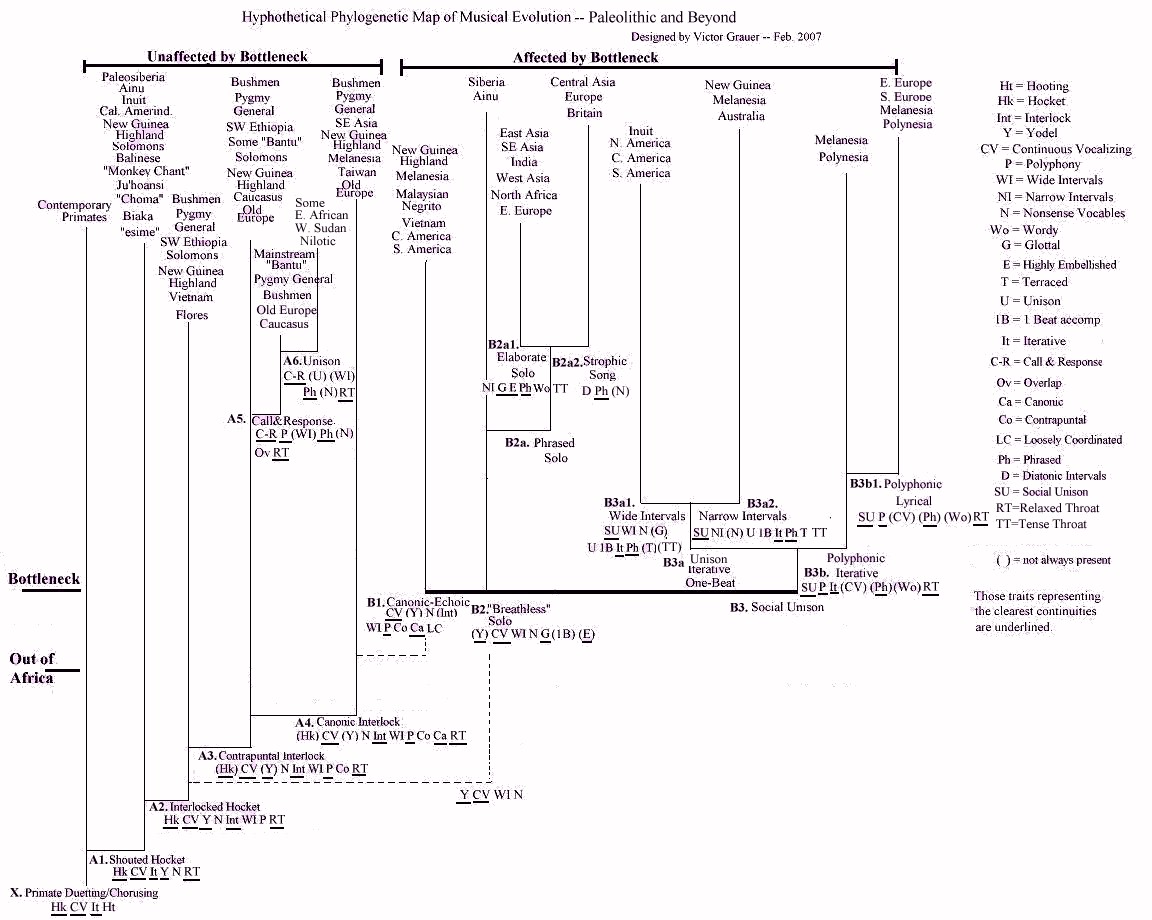
To get a better handle on the problem posed by the music of the Australian Aboriginals, let's take another look at the phylogenetic tree I presented all the way back in Post number 12:


While the thinking behind this tree was, and still is, subjective, speculative and tentative, it remains useful, in my opinion, as a means of helping us visualize certain possibilities. (It's important, also, to understand that this is primarily a representation of vocal style -- instrumental music is represented only to the extent that it serves as an accompaniment to vocalizing. While instrumental music can be equally important, it is much more difficult to assess on a comparative basis.) While it might look at first glance like a conventional phylogeny, in which each new branch represents a progressively more complex or "creative" developmental stage, it actually represents something very different. Because, at heart, my approach to musical "evolution," and, to some degree, cultural evolution generally, is based on the following principle, as expressed in my essay, "Echoes of our Forgotten Ancestors" -- what I call the "principle of sociocultural inertia": a tendency on the part of any human group to retain the most deeply ingrained and highly valued elements of its lifestyle until acted upon by some outside force (10).

If I could ever be accused of having a "pet theory" that I would go to great lengths to defend, it just might be encapsulated in this principle. And it should go without saying that I regard music, or at least musical style (for want of a better word), as among the most "deeply ingrained and highly valued elements" of human culture, especially so among those peoples who have not yet reduced it to a specialized form of entertainment ("Pop" or "Rock") or enlightenment ("Classical" or "Sacred" or, again, "Rock") given over to the hands of professionals.

In accord with this principle, most (though probably not all) the branchings in this tree can be understood, not as stages in a developmental process, but as the result of some sort of breakdown, due to an encounter with some "outside force," such as the encroachment of a more powerful and aggressive society, or a natural catastrophe (such as the Toba explosion, but also a Tsunami, earthquake, famine, drought, etc.) of the sort that can decimate a population and turn life upside down for the survivors. By analogy with the genetic concept of a "population bottleneck," such encounters can result in "cultural bottlenecks," where certain traditions may be lost and replaced by something different, due to resulting "founder effects" -- either somewhat different or completely different, depending on factors that are in many cases impossible to predict. I'll add that very often population bottlenecks, of the sort studied by population geneticists, can easily result in cultural bottlenecks, so cultural (and of course musical) "founder effects" can often be correlated with genetic ones. For more on the phylogenetic tree generally, see Post 12 et seq.

If we look for the word "Australia" on this tree, we will find it in only one place, just above the musical "clade" (branch) labeled B3a2. This clade stems from a deeper one, B3a, labeled "Unison/ Iterative/ One-beat." B3a, in turn, stems from B3, "Social Unison." You'll note that there is nothing beneath B3, no deeper clade which might have given rise to it. Instead, we see a thick horizontal line linking it with its sister clades, B1 and B2. If you now look all the way to the left, you'll see, in the margin, the word "Bottleneck." And if you look directly above the thick horizontal line, you'll see "Affected by Bottleneck." What we see in superhaplogroups B1, B2 and B3 is an attempt on my part to perform an educated guess as to what the musical effects of a major bottleneck event, such as the Toba eruption, or a Tsunami, etc., might have been. And since such an event would have been both devastating and relatively abrupt, it's not difficult to conclude that the effects would also have been both devastating and abrupt -- or in the words of the evolutionists, "saltational" (i.e., involving a sudden leap rather than a gradual transformation).

I placed nothing beneath B3 because there is little or nothing in SubSaharan African music that could be seen as a supporting "branch" for this particular style. Most SSAfrican music, both vocal and instrumental, is interactive, based either on closely interlocking, "contrapuntal" parts, as with P/B and its variants, or the well known "call & response" so characteristic of Bantu and African-American music. Much is also polyphonic, ranging from free counterpoint, to canon, to singing in parallel harmonies in either 4ths and 5ths or 3rds. We do find unison singing among certain African groups, but this practice appears to have developed relatively late.

As I've already argued, many posts ago, the type of vocalizing most likely to have been practiced by the original Out of Africa migrants (HMP) would have been P/B or some near variant, in other words music that is highly interactive, closely interlocked and polyphonic. B3, on the other hand, is called "Social Unison" because all the singers sing together more or less in lock step rhythmically throughout, with little or no leader-chorus interchange, a practice almost unheard of in SSAfrica. There are two B3 branches, one unison (B3a), the other polyphonic (B3b), and since polyphony is so common in Africa it's possible that B3b preceded B3a, which may have lost its polyphony as the result of a subsequent bottleneck event. It's also possible, as implied by the diagram, that both branches represent independent responses to the major bottleneck, by at least two different groups.

(to be continued . . . )


Sunday, February 7, 2010

308. Aftermath 23: Australia and New Guinea

Even if we assume that the hypothetical scenario I've been presenting is more or less on-track, a particularly challenging problem remains: the origin of the remarkable musical style that, as far as I've been able to determine, is characteristic of just about every Australian Aboriginal group throughout all regions of the continent. While there do seem to be some intriguing similarities between the dance styles of the Chenchu and Australian Aboriginals, as noted in Post 299, I've never been able to find any musical practice anywhere in South Asia that resembles the "unison/ iterative/ one-beat" style of the Australians.

I've been accused of going too far, at times, to justify my "pet theory" of musical evolution, and my attempt to account for Australian Aboriginal music in terms of some sort of bottleneck event, possibly due to the Toba eruption, is seen as a perfect example of how I am forced to go to unlikely extremes in order to make my theory work. No matter how many times I repeat myself, it seems to do no good, but just for the record: I do not have a theory of musical evolution, or evolution generally, either "pet" or otherwise. I am, very simply, trying to make sense of what happened in early human history, in terms of the various types of evidence available to me. To that end, I find it convenient to explore certain possibilities, in the form of testable hypotheses, which I then try, as best I can, to put to the test.

Since by far the strongest and most promising evidence comes from the realm of population genetics, and the strongest and most promising hypothesis is the "Out of Africa" model, my principal effort for the last several years has been to explore as fully as I can what that model implies for both musical and cultural evolution -- to determine whether what I know or think I know about the musical picture especially is or is not consistent with what I am learning about the picture currently being painted by the intrepid geneticists. If I can't get the pictures to coordinate into some sort of focus, then I will be forced to consider some other alternative. And that will be fine with me. If I were in it for the robe and bowl,* the course of my entire life would have been very different, I can assure you. I am here strictly and exclusively for the Dharma. (Though a bowl full of rice -- in the form of a grant -- would, from time to time, be welcome.)

If there is a "pet theory" to be justified by the bottleneck I have in mind, it is not a theory of music, but the "Out of Africa" theory itself. Because the existence of Australian Aboriginal "unison/ iterative/ one-beat" style is, on its face, very difficult to explain as an "evolutionary development" from anything remotely African. And if we might want to explain it away as an "independent invention," we would still be left with the problem of why such an invention was needed in the first place, if the ancestors of the Australians already had a perfectly viable musical tradition, with roots, like the Australians themselves, in Africa. On its face, the profound difference between this style and the P/B style I've associated with our HBP ancestors, and the HMP migrants, is so great as to be more consistent with the very different multi-regional model.

According to the multi-regionalists, the great diversity we see in the world of today, genetic, morphological and cultural is due to the fact that modern humans developed more or less independently in different regions of the world, so that things we have in common, like language, music, ritual, myth, marriage customs, kinship systems, religion, etc., must be the product of convergent evolution, i.e., some sort of "destiny," based on certain universal properties of the human mind that cause it to develop along certain lines and not others. A somewhat softened version of this model claims that many of these similarities must be due to various processes of genetic and cultural interchange due to the continual migration of various peoples throughout the world over millions of years. And any differences, such as the many differences between P/B and "Unison/ Iterative/ One-beat," wouldn't need explaining, since they would be due to the fact that these two styles arose under completely different circumstances, in completely different regions of the world. Any version I've ever heard of the multi-regional model makes little sense to me, while the Out of Africa model makes a great deal of sense. So, if the music of the Australian Aborigines can't somehow be accounted for by some version of Out of Africa, then I have to admit I'm stumped and will need to start over.

(to be continued . . . )

*From the Mumonkan: The Sixth Patriarch was pursued by the monk Myõ as far as Taiyu Mountain. The patriarch, seeing Myõ coming, laid the robe and bowl on a rock and said, "This robe represents the faith; it should not be fought over. If you want to take it away, take it now." Myõ tried to move it, but it was as heavy as a mountain and would not budge. Faltering and trembling, he cried out, "I came for the Dharma, not for the robe."

Saturday, February 6, 2010

307. Aftermath 22: Australia and New Guinea

17. If my scenario is correct, we should expect to find the following population types in what was formerly the Sahul:

[Added Feb. 7: The above sentence should be rephrased as follows: "If my scenario is correct, then the current situation in the former Sahul could be described in the following terms:"]

1. in Australia, Aborigines with Australoid morphology and Aboriginal hunter-gatherer culture, speaking, for the most part, a Pama-Nyungan language ; 2. in New Guinea, descendants of the original "Negrito" settlers, possibly with a degree of Australoid intermixture, now surviving mostly in the highlands, but also along portions of the coast, living as foragers and part-time horticulturalists -- speaking various "Papuan" languages, though in some cases -- especially along the coast -- Austronesian languages, and retaining at least some of their original African traditions; 3. in New Guinea, descendants of Australian Aborigines formerly based on the New Guinea coast, now living for the most part in the highlands as forager/horticulturalists, possibly intermixed with population 2, both biologically and culturally -- also speaking "Papuan" or in some cases Austronesian languages; 4. relatively recent Austronesian immigrants, speaking Austronesian languages, and inhabiting, for the most part, the northern coastal and lowland areas of New Guinea; practicing an essentially Neolithic, agriculture-oriented culture, with roots in Southeast Asia and strong connections with Polynesia -- but in certain respects also influenced by neighboring Papuan speakers, and in certain cases even speaking Papuan languages.

18. The phylogenetic tree I presented in Post 301, (from the 2003 paper by Max Ingman and Ulf Gyllensten, Mitochondrial Genome Variation and Evolutionary History of Australian and New Guinean Aborigines [11]), appears, in certain respects, to reflect the fourfold population structure outlined above*:


[Click on the image to enlarge.] For example, the cluster labeled "2a" is a mixture of New Guinea highland and coastal groups, along with a single representative of the Nasioi speakers of Bougainville, in the Solomon Islands. Since Papuan (i.e., non-Austronesian) speakers can be found in both the highlands and the coast, and since Nasioi is a Papuan language, this cluster could be seen, hypothetically, as representative of population group 2, as defined above, i.e., descendants of the original "Negrito" settlers. Since all but one of the groups represented in cluster "1b" are from the highlands, and thus in all likelihood also Papuan speakers, this cluster could also be assigned to group 2. Clusters "1c" and "1d," on the other hand, represent a mix of New Guinea highlanders and Australians, suggesting that the New Guineans in these samples might have originated in group 3, i.e., highland populations in New Guinea formerly centered along the coast, who are not "Negrito" descendants, but originated as Australoid immigrants. There are in addition several unhighlighted clusters (in block 1 only) representing purely Australian groups, which can unproblematically be assigned to population group 1, i.e., Australian Aborigines descended from the original Australoid immigrants. Finally, cluster "1a," a mix of Polynesian and New Guinean coastal populations, most likely belong to group 4, i.e., Austronesian speaking Neolithic farmers, living for the most part along the northern coast of New Guinea, but biologically and culturally most closely associated with Southeast Asia and Polynesia. The above picture, in addition to being highly speculative, is clouded by the authors' failure to identify the specific groups sampled (with the exception of the Nasioi), and also the tendency of Melanesian peoples generally to borrow cultural elements from one another, including not only tools and farming methods, but also rituals, musical instruments and even, on occasion, specific musical practices, at least to some extent. So clearly much more research will be necessary before the hypothesis in question can be adequately tested.

19. In 2007, on the basis of Cantometric evidence, supplemented by a renewed survey of available recordings and field studies, I put together a report entitled "The Musical Affinities of Some Melanesian Groups." Interestingly, my study produced musical "families" closely correlated with the grouping presented above. The first such family consisted of "Groups Exhibiting Strongest Association with African Pygmy/Bushmen style," i.e., those groups most closely associated musically with the culture of the original Out of Africa migrants (HMC). A second family was characterized by a variant of P/B style that I've called "canonic-echoic." In both cases, all but one of the 12 groups from New Guinea were located in the highlands, and all were Papuan speakers, strongly suggesting membership in population group 2, as defined above. Another style family was "Groups Exhibiting Strongest Association with Indigenous Australia – Unison Singing with 1-beat Accompaniment." Interestingly, only one group from island Melanesia was represented here, along with a mix of 5 New Guinea groups from both the highlands and coastal areas, suggesting membership in group 3. The last category, corresponding to group 4, was "Groups Exhibiting Strongest Association with Western Polynesia," with typically Polynesian characteristics, such as "polyphonic group vocalizing in either rhythmic unison . . . or some form of simple antiphony, with good to excellent tonal blend, medium interval width, wordy . . ." In New Guinea, these were mostly coastal groups, with only one highland group represented -- along with the inhabitants of the Torres Straits, whose culture has been described as closer to Melanesia than Australia, and who may well have been exposed to Austronesian influence. Again, this picture may be distorted by the tendency of some of these groups to borrow rituals, instruments and in some cases even particular songs from one another. Nevertheless, I find the parallels between the historical scenario, the genetic evidence and the musical evidence to be compelling and definitely worthy of further investigation.

*As you may recall, this tree is a bit unusual, as it's based on the mtDNA coding region rather than the noncoding "neutral markers" of the "D-loop," which has usually been the focus of this sort of research in the past. For this reason, the authors chose to forego the usual haplogroup terminology (L, M, N, etc.), which could be misleading. Nevertheless, the clades grouped under the labels "1" and "2" are to be understood as essentially equivalent to mtDNA superhaplogroups "N" and "M" respectively.

Thursday, February 4, 2010

306. Aftermath 21: Australia and New Guinea

12. Monash University has a very interesting website that provides detailed information on sea levels from roughly 100,000 ya to the present, coupled with a map of the Sahul. It's interactive, so you can run your mouse over the timeline to see where sea levels were at any given time and how they affected what is now New Guinea, Australia and Tasmania. As we can see from the map, sea level rose very rapidly from about 25,000 ya to roughly 7,400 ya. when it reached more or less the same level it has today. Extrapolating backward, we can imagine the situation as it may have existed, according to the hypothesis I'm exploring, once the three regions were completely separated: 1. Australia would by then have been largely populated by Australoid peoples similar to those who now form the great majority of Australian aboriginals; 2. the Queensland tropical forest could have served as a refuge area for a small segment of the original "Negrito" population; 3. Tasmania, now an island, could have been another refuge for descendants of the same original group; 4. New Guinea would have been populated largely by refugees, descended from the original Sahul settlers, living mostly in the mountains, surrounded by Australoid "invaders" living along the coast.

13. At some point, a form of agriculture characterized by simple gardening (horticulture) develops in New Guinea, either among the highland "Negritos" or the coastal "Australoids," and spreads rapidly throughout the island. Australia, now largely or completely separated from New Guinea, is unaffected by this development and the Australians remain hunter-gatherers right up until first contact with the West.

14. Because Australia is largely flat terrain and also because of the remarkable ability of Australian aborigines to walk great distances, the entire continent tends toward a remarkable homogeneity, both morphologically and culturally. For example, a single language family, Pama-Nyungan, dominates almost the entirety of the continent, in contrast to New Guinea, which currently harbors over 1,000 languages divided into "about three dozen language families and close to the same number of language isolates" (The Languages of New Guinea, William Foley). The very different distribution pattern for language families in Australia is clearly visible in the following map (from the Wikipedia article, Indigenous Australian Languages).


The huge yellow region is where Pama-Nyungan languages are spoken, while the much smaller, multi-colored region to the north contains just about every other language family on the continent. Significantly, these northern languages are located just to the south of where an enormous land bridge once connected Australia and New Guinea (see map on Post 297). It's tempting to speculate that this northern region might once have served as a refuge area for groups of besieged "Negritos," possibly a jumping-off point for the voyage north. If the invaders ultimately captured their women, taking them as wives, it's possible that their languages might have survived the destruction of the rest of their culture.

15. The striking difference between the linguistic pictures for the two islands is paralleled in the realm of music, with New Guinea currently harboring a variety of different vocal styles, with a wide range of different polyphonic types, some with strong African echoes, and a large number of different instruments and instrumental ensembles, while native Australian vocalizing, almost exclusively monophonic and highly iterative, is remarkably homogeneous stylistically, with only a very few relatively simple instruments, aside from the Didgeridoo, which is rarely performed in ensembles of any kind. It's important to recognize, however, that within the very broad limits of the style I've called "unison/iterative/one-beat" there is considerable diversity among various Australian groups, and also a very impressive degree of subtlety, rhythmic intricacy and structural elaboration, often coordinated with some of the most remarkable poetry and dancing to be found anywhere in the world. When we couple this with some of the most complex and intellectually challenging ritual, mythical, and genealogical traditions to be found anywhere in the world, along with equally remarkable visual art traditions, which even today can challenge the finest examples of Western art, it should be clear that when I characterize Australia as culturally "homogenous" this should not be construed as implying that these traditions are in any way simplistic or inferior. I'll have more to say about the music of Australia and New Guinea in future posts.

16. The next important event in the history of this region is the advent of the so-called "Austronesians," who are thought to have migrated to various points in New Guinea and Island Melanesia anywhere from 6,000 to roughly 4,000 years ago. The origin and early migration routes of the Austronesians remain a much-debated mystery, which need not concern us here. For some reason there is little if any evidence that any Austronesians ever landed anywhere in Australia, possibly due to the protective function of the Great Barrier Reef. However, they did land in New Guinea, where a great many Austronesian languages are spoken today, though almost exclusively in certain lowland areas, along the northern coast. Apparently, the newly arrived Austronesians displaced the New Guinea natives living along the coast, with results that are complex and only partly understood even today. In some cases it would seem as though the native populations remained put, but adopted Austronesian languages and also farming techniques. In other cases, it's almost certain that at least some groups took to the highlands, which once again would have served as a refuge area. As far as the scenario I'm developing is concerned, the "native" populations along the coast would at that time have been largely Australoid groups (see paragraph 11 in Post 305), while those inhabiting the highland regions would have been the descendants of the original "Negrito" settlers. With the advent of the Austronesians, therefore, and the retreat into the highlands of at least some of the Australoid groups, the highlands would have come to harbor a mixed population, partly of "Negrito" origin (though by now probably for the most part no longer Pygmoid) and partly of Australoid origin. Since these groups would have formerly, according to my scenario, been bitter enemies, it's not difficult to see how the endemic warfare we now see in the New Guinea highlands could have originated at this point.